Belarus Military Forces
Open-source order of battle for 2026: 45,350 active troops, 205 aircraft, 2,636 ground vehicles.
Armed Forces in 2026
| Domain | Strength | Composition |
|---|---|---|
| Air Force and Air Defence Forces of the Republic of Belarus | 205 aircraft | 100 combat 80 helicopters 11 air bases +4 on order |
| Ground Forces | 2,636 vehicles | 507 main battle tanks |
| Nuclear Forces | Host | 50 hosted Land |
| Personnel | 45,350 active | 289,500 reserve 110,000 paramilitary |
Global Military Index
Full ranking →| Pillar | Weight | Score | Basis |
|---|---|---|---|
| Manpower | 15% | 73.4 | Active, reserve & paramilitary personnel |
| Ground forces | 20% | 62.0 | Tanks, armor & artillery weighted by type |
| Naval power | 20% | 0.0 | Weighted by hull type: carrier tiers, nuclear vs conventional submarines |
| Air power | 25% | 48.9 | Weighted by aircraft type and fleet age |
| Nuclear deterrent | 10% | 4.3 | No declared nuclear capability |
| Defense budget | 10% | 44.2 | Annual spending, purchasing-power adjusted |
| Readiness | modifier | ×0.99 | Budget per soldier: proxy for training, maintenance & technology |
Country File
| Population | 9.1M (2024) |
| GDP | $76.0 billion (2024) |
| GDP per capita | $8,318 |
| Military budget | $1.5 billion (2024) |
| Share of GDP | 2.0% (2024) |
| Military spending per capita | $166 (2024) |
| Inflation rate | 5.79% (2024) |
| Capital | Minsk |
| Region | Europe |
| Land area | 202,900 km² |
| Land borders | 2,900 km |
| Bordering countries | 5 |
| Currency | BYN |
Strategic Overview in 2026
Strategic Position
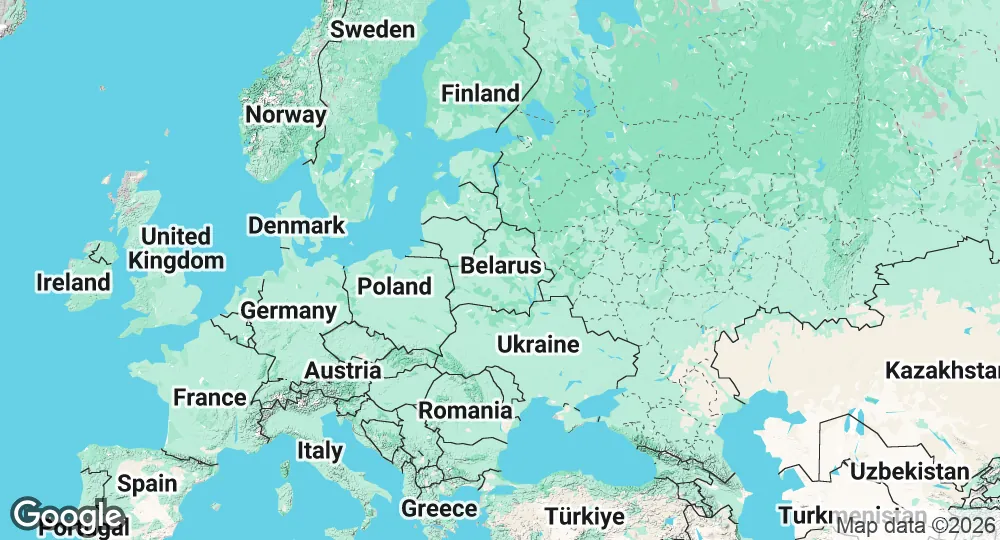
Belarus occupies a landlocked position in Eastern Europe, bordering NATO members Poland, Lithuania, and Latvia to the west and north, and Ukraine to the south. National defense is organized within the framework of the Union State with the Russian Federation and the Collective Security Treaty Organization (CSTO). In 2025, Belarus formalized an updated military doctrine that codifies strategic integration with Russian defense priorities, establishing that an attack on either member of the Union State constitutes an act of aggression against both.
The military posture is characterized by a shift from defensive neutrality to active participation in a joint regional grouping of forces with Russia. The 2026–2030 defense plan, approved in late 2025, prioritizes the reinforcement of the southern border with Ukraine and the western frontiers. Belarus serves as a platform for Russian military assets, including air defense systems, aviation units, and tactical nuclear components.
Military Forces
The Armed Forces of Belarus comprise approximately 63,000 active personnel and 350,000 reserve personnel. The command structure is centralized under the Ministry of Defense and the General Staff. Service branches include the Ground Forces, the Air Force and Air Defense Forces, and the Special Operations Forces (SOF).
The Ground Forces operate a fleet of main battle tanks consisting primarily of T-72B and modernized T-72B3 variants. Infantry units utilize BMP-2 infantry fighting vehicles and BTR-80/82A armored personnel carriers. Specialized equipment includes the Volat V-2 domestic armored personnel carrier. Artillery capabilities are based on the Polonez multiple launch rocket system (MLRS) and various Soviet-legacy platforms.
The Air Force and Air Defense Forces maintain Su-30SM and Su-30SM2 multirole fighters and Su-25 ground-attack aircraft, the latter of which are modified for nuclear delivery. Air defense is integrated with the Russian regional system, utilizing S-400 and S-300 long-range surface-to-air missile (SAM) systems, alongside Tor-M2K and Buk-MB variants.
The SOF consists of three primary brigades: the 38th Air Assault, 103rd Airborne, and 5th Spetsnaz. In 2025, Belarus began forming new SOF units and anti-aircraft missile regiments in the southern Gomel and Mozyr regions. Specialized capabilities include tactical nuclear weapons delivery via Iskander-M missile systems. By 2026, the military plans to operationalize Oreshnik hypersonic missile systems in coordination with Russian forces.
Defense Industry
The State Defense Industry Committee oversees a network of domestic manufacturers specializing in electronic warfare, optics, and heavy chassis production. Minsk Wheel Tractor Plant (MZKT) provides the "Volat" heavy-duty chassis used by both Belarusian and Russian missile systems. Peleng produces optoelectronics and fire control systems for armored vehicles.
Domestic production includes the Polonez MLRS, developed with international cooperation, and a range of unmanned aerial vehicles (UAVs) such as the Chekan-V and Peacemaker. KB Radar produces electronic warfare and signals intelligence systems. In 2025, the 558th Aircraft Repair Plant entered joint production with Russian entities for the Osvei light multipurpose aircraft and maintained capabilities for Su-25 and Su-30 modernization.
Strategic Trends
Defense spending in 2025 is approximately 2% of GDP, totaling 4.7 billion Belarusian rubles. This follows a steady increase in military allocations since 2023. Procurement priorities focus on the acquisition of Su-30SM2 fighters, Mi-35M attack helicopters, and integrated drone systems.
Future force structure shifts involve the expansion of the Territorial Defense Troops and the creation of specialized UAV units within mechanized brigades. Strategic exercises, such as Zapad-2025, emphasize the practice of repelling regional aggression and the planning of tactical nuclear strikes. The primary constraint facing the military is a reliance on Russian financial and technical support for modernization and the maintenance of sophisticated air defense and missile platforms.
Frequently Asked Questions
How large is Belarus's military?
What is Belarus's defense budget?
How does Belarus rank militarily in the world?
Does Belarus have nuclear weapons?
How many aircraft does Belarus's air force have?
How many tanks does Belarus have?
What percentage of GDP does Belarus spend on defense?
What is Belarus's military personnel per capita?
Does Belarus have paramilitary forces?
Military Expenditure: CIA World Factbook. Suggest a change