Ireland Military Forces
Ireland ranks #97 of 170 militaries worldwide in 2026, with 9,500 active troops. The Air Force flies 27 aircraft; the Navy operates 32 warships. Ireland has no nuclear weapons.
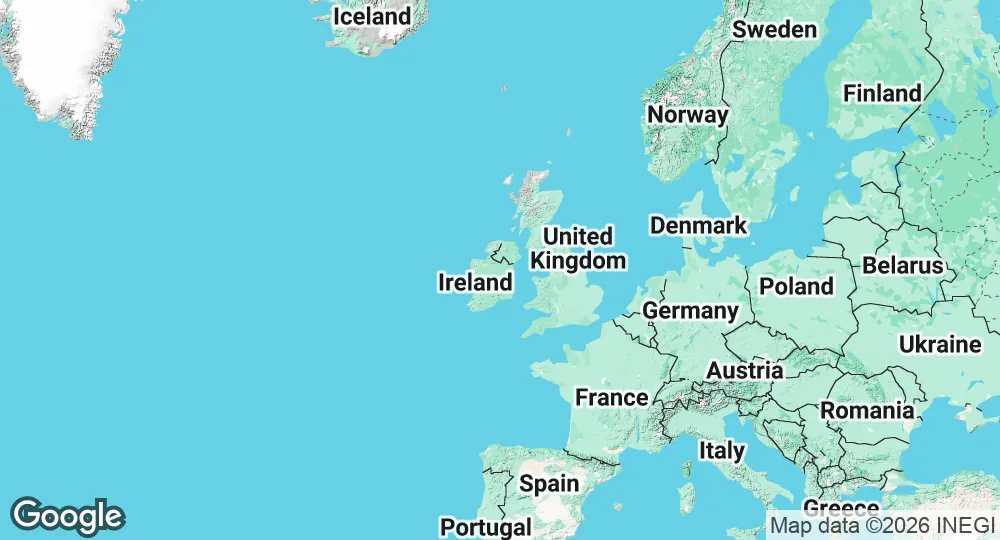

Armed Forces in 2026
| Domain | Strength | Composition |
|---|---|---|
| Irish Air Corps | 27 aircraft | 10 helicopters 2 air bases |
| Irish Naval Service | 32 warships | |
| Personnel | 9,500 active | 4,050 reserve |
ATLAS Index (Aggregate Total of Land, Air and Sea strength)
Full ranking →| Pillar | Weight | Score | Basis |
|---|---|---|---|
| Manpower | 10% | 24.8 | Active, reserve & paramilitary personnel |
| Ground forces | 20% | 0.0 | ARMS inventory power: armour & artillery by type and era, attack helicopters, armament |
| Naval power | 20% | 24.4 | SEAS inventory power: hulls by type, size and era, air wing, sustainment, armament |
| Air power | 25% | 17.7 | AIRS inventory power: aircraft by type and generation, enablers, armament |
| Nuclear deterrent | 10% | 0.0 | No declared nuclear capability |
| Defense budget | 15% | 19.4 | Annual spending, purchasing-power adjusted |
| Availability | modifier | ground ×1.03 · naval ×0.91 · air ×1.07 | Budget per point of each force, from the branch indexes |
Country File
| Population | 5.4M (2024) |
| GDP | $609.2 billion (2024) |
| GDP per capita | $112,895 |
| Military budget | $1.2B (2024) |
| Share of GDP | 0.2% (2024) |
| Military spending per capita | $226 (2024) |
| Inflation rate | 2.11% (2024) |
| Capital | Dublin |
| Region | Europe |
| Land area | 68,883 km² |
| Coastline | 1,448 km |
| Land borders | 499 km |
| Bordering countries | 1 |
| Currency | EUR |
Strategic Overview in 2026
Strategic Position
Ireland maintains a long-standing policy of military neutrality, characterized by non-membership in mutual defense alliances such as NATO. This posture is governed by the "triple lock" mechanism, which requires a United Nations mandate, a government decision, and parliamentary approval (the Dáil) before Irish troops can be deployed to overseas missions. Ireland is a member of the European Union’s Permanent Structured Cooperation (PESCO) and the NATO Partnership for Peace (PfP) program.
Primary security concerns focus on the protection of sovereign airspace and the maritime domain. Ireland’s Exclusive Economic Zone (EEZ) contains high-density subsea fiber-optic data cables and energy pipelines connecting North America and Europe. In 2025 and 2026, defense policy has increasingly prioritized maritime domain awareness and the security of this critical undersea infrastructure. Lacking an independent primary radar system, the state relies on a long-term bilateral arrangement with the United Kingdom’s Royal Air Force to monitor and intercept unauthorized aircraft in its sovereign airspace.
Military Forces
The Irish Defence Forces (Óglaigh na hÉireann) consist of three permanent service branches: the Army, the Naval Service, and the Air Corps. The President of Ireland is the Supreme Commander, though the Minister for Defence exercises authority through the Department of Defence. Active personnel strength is approximately 7,500, supplemented by a reserve component of approximately 1,700.
Army The Army is the largest branch and is structured into two territorial brigades (Eastern and Southern) and a specialized training center. Its primary role is aid to the civil power and international peacekeeping. Equipment includes Mowag Piranha III armored personnel carriers, RG-32M light tactical armored vehicles, and L118 105mm towed howitzers.
Air Corps Based at Casement Aerodrome, the Air Corps provides maritime patrol, transport, and support capabilities. It operates C-295 maritime patrol aircraft, PC-9M light attack and training aircraft, and AW139 utility helicopters. Procurement programs in 2025 include the acquisition of H145M light utility helicopters to replace aging airframes.
Naval Service Operating from Haulbowline, the Naval Service is responsible for fisheries protection and maritime security. The fleet includes Samuel Beckett-class (P60) offshore patrol vessels and Róisín-class (P50) large patrol vessels. In late 2024, two Aoibhinn-class (P70) inshore patrol vessels were commissioned to enhance coastal monitoring.
Special Forces The Army Ranger Wing (ARW) is the primary special operations unit. Under a restructuring program active in 2025 and 2026, the unit is transitioning to a new command structure titled "Ireland Special Operations Force" (IRL SOF), which includes dedicated land, air, and maritime task groups. A new headquarters and training facility at the Curragh is scheduled for completion in 2027.
Defense Industry
Ireland possesses a limited domestic defense industry and relies almost entirely on foreign procurement for its military needs. Domestic production is restricted to specialized vehicle components and software. Primary suppliers include Switzerland for armored vehicles, Spain for transport aircraft, and Italy for helicopters. In 2025, Ireland entered negotiations with France for the procurement of its first national primary radar system.
Strategic Trends
The Irish government is currently implementing the "Level of Ambition 2" (LOA2) framework, which aims to modernize the force structure by 2028. The defense budget reached approximately €1.5 billion in 2026, representing an increase in nominal spending while remaining one of the lowest in Europe as a percentage of GDP, at approximately 0.2%.
Key modernization priorities for 2025 and 2026 include:
-
Military Radar Programme (MRP): The development of a land-based primary radar capability to monitor Irish airspace independently.
-
Subsea Awareness: Investment in towed array sonar systems and underwater surveillance technology to protect subsea cables.
-
Cyber Defense: The expansion of a dedicated Cyber Command to counter hybrid threats to national utilities.
-
Force Stabilization: Addressing a persistent recruitment and retention crisis. While induction numbers showed an upward trend in 2025, total personnel remain below the target establishment of 9,739.
Security preparations for Ireland's 2026 EU Presidency have driven short-term investments in counter-unmanned aerial systems (C-UAS) and infrastructure upgrades at major military installations.
Military Expenditure: CIA World Factbook. Last updated on 4 August 2026. Suggest a change
Irish Defense Manufacturing
Designed in IrelandFrequently Asked Questions
How large is Ireland's military?
What is Ireland's defense budget?
How does Ireland rank militarily in the world?
Does Ireland have nuclear weapons?
How many aircraft does Ireland's air force have?
How large is Ireland's navy?
What percentage of GDP does Ireland spend on defense?
What is Ireland's military personnel per capita?
- AUG 42026 Updated Global Military Index updated in a site-wide editorial pass
- JUL 162026 Updated Global Military Index updated in a site-wide editorial pass
- JUN 162026 Updated Yearly statistics, military spending and 2 more fields updated
- JAN 132026 Updated Description updated