Madagascar Military Forces
Madagascar ranks #130 of 169 militaries worldwide in 2026, with 13,500 active troops. The Malagasy Army fields 6 main battle tanks; the Air Force flies 5 aircraft. Madagascar has no nuclear weapons.
Armed Forces in 2026
| Domain | Strength | Composition |
|---|---|---|
| Air Force | 5 aircraft | 4 helicopters +2 on order |
| Ground Forces | 6 tanks | |
| Personnel | 13,500 active | 8,100 paramilitary |
ATLAS Index (Aggregate Total of Land, Air and Sea strength)
Full ranking →| Pillar | Weight | Score | Basis |
|---|---|---|---|
| Manpower | 10% | 25.3 | Active, reserve & paramilitary personnel |
| Ground forces | 20% | 14.1 | ARMS inventory power: armour & artillery by type and era, attack helicopters, armament |
| Naval power | 20% | 0.0 | SEAS inventory power: hulls by type, size and era, air wing, sustainment, armament |
| Air power | 25% | 10.6 | AIRS inventory power: aircraft by type and generation, enablers, armament |
| Nuclear deterrent | 10% | 0.0 | No declared nuclear capability |
| Defense budget | 15% | 10.7 | Annual spending, purchasing-power adjusted |
| Availability | modifier | ground ×0.80 · naval ×1.00 · air ×1.00 | Budget per point of each force, from the branch indexes |
Country File
| Population | 32.7M (2025) |
| GDP | $19.6 billion (2025) |
| GDP per capita | $599 |
| Military budget | $122M (2024) |
| Share of GDP | 0.7% (2024) |
| Military spending per capita | $4 (2024) |
| Inflation rate | 8.05% (2025) |
| Capital | Antananarivo |
| Region | Africa |
| Land area | 581,540 km² |
| Coastline | 4,828 km |
| Currency | MGA |
Strategic Overview in 2026
Strategic Position
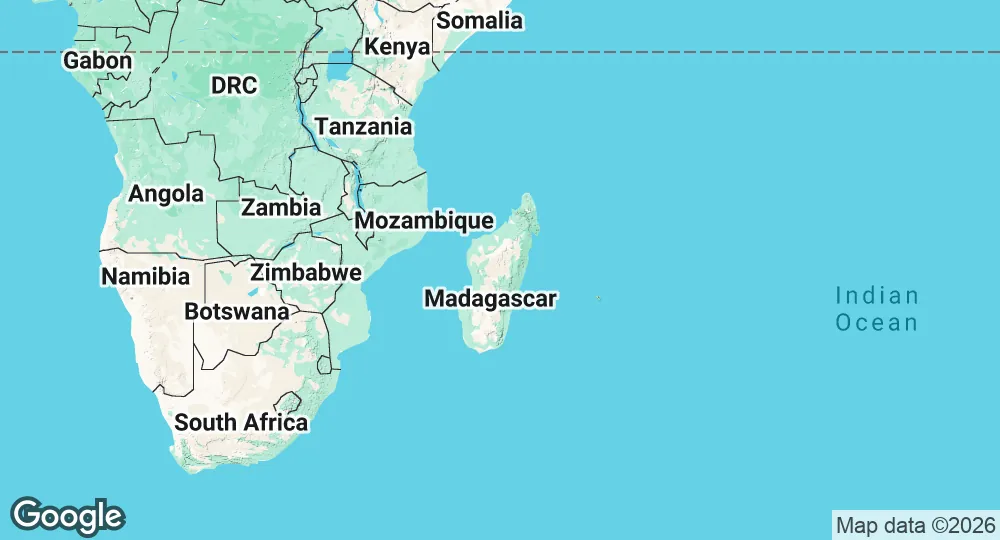
Madagascar occupies a maritime position in the Western Indian Ocean, overseeing the Mozambique Channel, a primary transit route for global shipping. Its primary security concerns include maritime piracy, illegal, unreported, and unregulated (IUU) fishing, and the illicit trafficking of natural resources. Following an October 2025 military coup led by Colonel Michael Randrianirina, the country transitioned to a military-led government, resulting in its suspension from the African Union (AU) and a pause in some Western security assistance programs.
The defense posture is undergoing a shift from traditional Western partnerships, particularly with France and the United States, toward increased cooperation with the Russian Federation. In December 2025, a bilateral agreement led to the delivery of Russian military hardware and the arrival of approximately 40 military instructors to train the Malagasy Armed Forces. Madagascar remains a member of the Southern African Development Community (SADC) and the Indian Ocean Commission (IOC), though its regional standing is currently influenced by the 2025 political transition and subsequent AU suspension.
Military Forces
The Malagasy Armed Forces (Tafika Malagasy) are under the command of the Ministry of National Defense and are organized into three primary branches: the Army, the Navy, and the Air Force. The National Gendarmerie serves as a significant paramilitary force focused on internal security and rural policing. Total active personnel is approximately 21,000, with the Army comprising 18,000, the Navy 2,000, and the Air Force 1,000. The National Gendarmerie maintains a strength of approximately 12,000.
Army
The Army is the dominant branch and is organized into military regions. It maintains a light armored capability for reconnaissance and internal security. The inventory includes PT-76 light tanks and BRDM-2 armored scout cars. It also fields Panhard AML-90 and AML-60 armored cars. In late 2025, the Army received a shipment of Russian equipment, including anti-tank rocket launchers, sniper rifles, and assault rifles. The CAPSAT (Corps d'Armée du Personnel et des Services Administratifs et Techniques) remains an influential elite unit within the command structure.
Navy
The Navy focuses on coastal surveillance and patrol. It operates a fleet of patrol vessels, including the Trozona (an ex-French P400 class vessel) and various interceptor craft provided by international partners. Operations are coordinated through maritime information fusion centers in Antananarivo to monitor the Exclusive Economic Zone.
Air Force
The Air Force provides transport, utility, and reconnaissance capabilities. Its fixed-wing fleet includes An-26 and C-212 transport aircraft, alongside Cessna 172 and 206 utility planes. For light reconnaissance, the force utilizes Tetras aircraft. The rotary-wing inventory consists of Alouette II, Alouette III, and Gazelle helicopters.
Strategic Trends
The current defense budget is approximately 0.7% of GDP, with expenditure estimated at $121 million USD for the 2025–2026 fiscal period. Modernization efforts are focused on rapid intervention and maritime domain awareness. The acquisition of FPV (First-Person View) drones in December 2025 indicates an intent to integrate low-cost unmanned aerial systems into reconnaissance and tactical operations.
A national cybersecurity strategy was launched in December 2025 to address vulnerabilities in critical infrastructure and combat digital threats. This initiative aims to establish a framework for incident response and digital forensics by mid-2026.
The military government faces significant constraints, including high rates of poverty and the withdrawal of some international fiscal support. Future force structure shifts are expected to prioritize the Presidential Guard and specialized units tasked with internal stability. Defense priorities continue to include the suppression of dahalo (organized cattle rustling) in the southern regions, which remains a primary source of domestic insecurity. While maintaining a dialogue with Russian and Chinese interests, the administration in 2026 continues to negotiate with the United States regarding strategic mineral sand projects and maritime security cooperation in the Diego-Suarez naval base area.
Military Expenditure: CIA World Factbook. Last updated on 25 September 2026. Suggest a change
Frequently Asked Questions
How large is Madagascar's military?
What is Madagascar's defense budget?
How does Madagascar rank militarily in the world?
Does Madagascar have nuclear weapons?
How many aircraft does Madagascar's air force have?
How many tanks does Madagascar have?
What percentage of GDP does Madagascar spend on defense?
What is Madagascar's military personnel per capita?
Does Madagascar have paramilitary forces?
- SEP 252026 Updated Population, GDP and inflation added for 2025; GDP series revised
- AUG 42026 Updated Global Military Index updated in a site-wide editorial pass
- JUL 162026 Updated Global Military Index updated in a site-wide editorial pass
- JUN 162026 Updated Yearly statistics, military spending and military spending share of GDP updated
- JAN 172026 Updated Main battle tank count and Global Military Index updated
- JAN 132026 Updated Description added