Palestine Military Forces 🇵🇸
Military Strength Overview
Geography
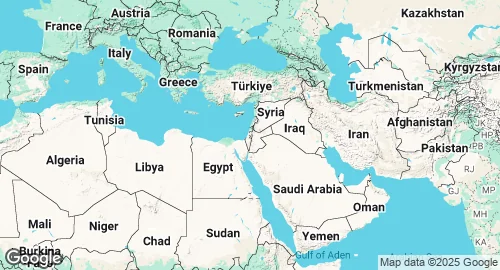
| Capital | Ramallah |
| Land Area | 6,000 km² |
| Coastline Length | 0 km |
National Flag

Defense Statistics & Key Metrics
| Population | 5.0 million (2022) |
| GDP | $19.2 billion (2022) |
| GDP per capita | $3800 (2022) |
| Inflation Rate | 3.74% (2022) |
| Military Personnel | 56,000 (2012) |
Population and Military Personnel Trends
GDP and Inflation Rate Trends
Strategic Overview in 2026
Strategic Position
The security posture of the Palestinian territories is characterized by a bifurcated and fragmented architecture, shaped by the Oslo Accords and the 2025 US-brokered ceasefire. Under international agreements, the Palestinian Authority (PA) is restricted from maintaining a standing national army, instead operating paramilitary security forces focused on internal stability and counter-terrorism. The primary security concern is the management of the Israeli-Palestinian conflict, including the monitoring of the "Yellow Line"—a de facto security boundary established in the Gaza Strip in late 2025.
Regional relationships are defined by security cooperation with the United States, facilitated through the United States Security Coordinator (USSC), and the European Union via the EUPOL COPPS mission. Egypt and Jordan serve as primary regional security partners, providing training and logistics for the PA. In the Gaza Strip, non-state armed groups maintain a doctrine of asymmetric warfare and deterrence centered on rocket systems and subterranean operations.
Military Forces
The Palestinian security apparatus comprises two distinct elements: the formal Palestinian Authority Security Forces (PASF) and various irregular armed factions.
The PASF consists of approximately 30,000 to 45,000 active personnel, primarily stationed in the West Bank. Command is centralized under the Ministry of Interior, with specific branches including: * National Security Forces (NSF): A paramilitary gendarmerie tasked with border security and internal order. * Presidential Guard: An elite unit responsible for executive protection and rapid response. * General Intelligence Service (GIS): The primary agency for external and internal intelligence gathering. * Civil Police: Tasked with law enforcement and public safety.
As of early 2026, an additional 9,000 police personnel are undergoing training in Egypt, Jordan, and the European Union to facilitate a transition of security responsibilities in the Gaza Strip. Equipment for the PASF is limited to light infantry weapons and light armored transport vehicles, such as the Al-Jawad and BTR series.
In the Gaza Strip, the Izz ad-Din al-Qassam Brigades (Hamas) and the Al-Quds Brigades (Palestinian Islamic Jihad) represent the primary irregular forces. These groups maintain thousands of active fighters organized into geographical brigades and battalions. Their capabilities include extensive subterranean tunnel networks, man-portable air-defense systems (MANPADS), and anti-tank guided missiles (ATGMs). Their rocket inventory ranges from short-range mortars to long-range projectiles capable of reaching deep into regional territory.
A planned International Stabilization Force (ISF), authorized under UN frameworks, is scheduled for deployment in 2026 to oversee demilitarization and stabilization efforts alongside the newly trained Palestinian police contingent.
Defense Industry
The Palestinian defense industry is limited to the clandestine production of asymmetric weaponry within the Gaza Strip. Domestic manufacturing focuses on rocket systems, including the Qassam, M-75, and R-160 series. Local workshops also produce the Al-Yassin 105 tandem-charge anti-tank projectiles and various improvised explosive devices (IEDs). These programs rely on the repurposing of unexploded ordnance and the smuggling of dual-use materials. The PASF in the West Bank has no domestic arms production and is entirely dependent on foreign imports and international donations approved by Israel.
Strategic Trends
The primary strategic trend in 2026 is the implementation of a comprehensive peace plan prioritizing the demilitarization of Gaza-based armed groups. Force modernization for the PA is focused on civil police capabilities and internal security infrastructure rather than conventional military expansion.
The defense budget for the PA remains heavily subsidized by international aid and is subject to the clearance of tax revenues by Israel. Strategic priorities include the integration of Gaza into a unified PA security umbrella and the establishment of a Board of Peace to oversee reconstruction. Constraints facing the security forces include the persistent autonomy of decentralized armed cells, the degradation of urban infrastructure, and the high political sensitivity surrounding security coordination with regional and international actors.
Frequently Asked Questions
Does Palestine have nuclear weapons?
Military Expenditure: SIPRI Milex. Suggest a change