Senegal Military Forces
Open-source order of battle for 2026: 13,600 active troops, 40 aircraft.
Armed Forces in 2026
| Domain | Strength | Composition |
|---|---|---|
| Air Force | 40 aircraft | 20 helicopters +3 on order |
| Personnel | 13,600 active | 5,000 paramilitary |
Global Military Index
Full ranking →Log-scaled composite · sources: CIA World Factbook, World Bank, SIPRI, IISS and GMNET inventories · the world's strongest military scores 100 · full methodology.
| Pillar | Weight | Score | Basis |
|---|---|---|---|
| Manpower | 15% | 49.5 | Active, reserve & paramilitary personnel |
| Ground forces | 20% | 0.0 | Tanks, armor & artillery weighted by type |
| Naval power | 20% | 0.0 | Weighted by hull type: carrier tiers, nuclear vs conventional submarines |
| Air power | 25% | 21.4 | Weighted by aircraft type and fleet age |
| Nuclear deterrent | 10% | 0.0 | No declared nuclear capability |
| Defense budget | 10% | 28.5 | Annual spending, purchasing-power adjusted |
| Readiness | modifier | ×1.00 | Budget per soldier: proxy for training, maintenance & technology |
Country File
| Population | 18.5M (2024) |
| GDP | $32.8 billion (2024) |
| GDP per capita | $1,773 |
| Military budget | $524.9 million (2024) |
| Share of GDP | 1.6% (2024) |
| Military spending per capita | $28 (2024) |
| Inflation rate | 0.8% (2024) |
| Capital | Dakar |
| Region | Africa |
| Land area | 192,530 km² |
| Coastline | 531 km |
| Land borders | 2,640 km |
| Bordering countries | 5 |
| Currency | XOF |
Strategic Overview in 2026
Strategic Position
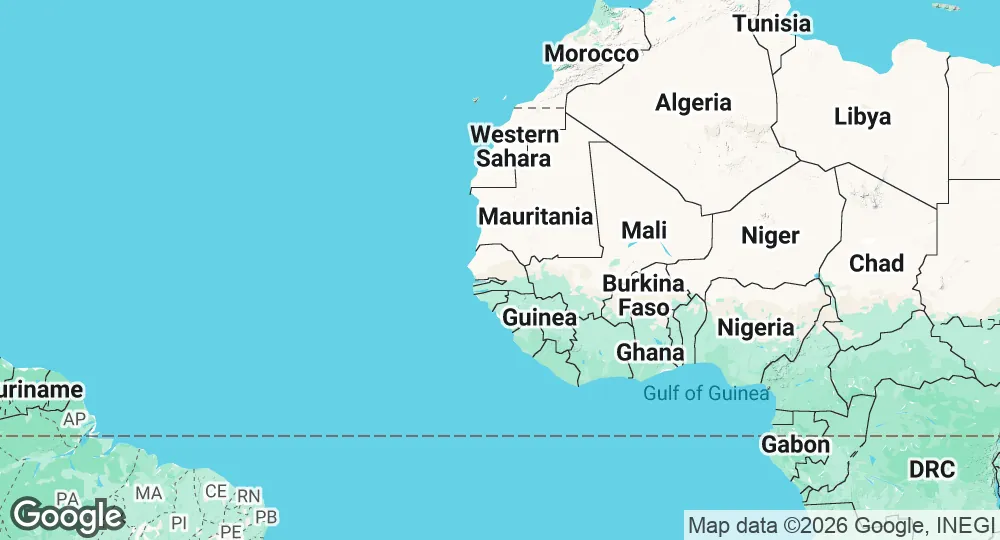
Senegal maintains a defensive posture focused on territorial integrity, maritime security, and regional stability. Geopolitically, the country acts as a buffer between the volatile Sahel region to the east and the Atlantic coastline. Primary security concerns include the potential spillover of militant Islamist activity from the Mali border, where groups such as JNIM and ISGS operate, and the long-running, low-intensity conflict in the southern Casamance region.
In a shift of defense doctrine effective in 2025, the Senegalese government initiated a policy of "diversified sovereignty," leading to the formal end of permanent foreign military bases on its territory. This included the July 2025 handover of the last French military installations, such as the Ouakam base, marking a transition from long-standing bilateral defense agreements with France toward a model of temporary, mission-specific technical cooperation. Senegal remains a member of the Economic Community of West African States (ECOWAS) and the African Union, and continues as one of the world's largest per-capita contributors to United Nations peacekeeping operations.
Military Forces
The Senegalese Armed Forces (Forces Armées Sénégalaises) are organized under the Ministry of the Armed Forces. The structure comprises the Army, Navy, Air Force, and the National Gendarmerie, a paramilitary force with significant internal security responsibilities. Total active personnel are approximately 19,000, supported by 10,000 gendarmerie and 5,000 reserve personnel.
Army The Army is the largest branch, structured into several military zones. It operates a mix of Western and Chinese hardware. Armor and reconnaissance capabilities include WMA-301 tank destroyers, AML-60 and AML-90 armored cars, and various infantry fighting vehicles. The fleet of armored personnel carriers and MRAPs has expanded with the acquisition of Turkish Ejder Yalcin and French Bastion vehicles.
Navy The Navy has undergone recent modernization to secure Senegal’s exclusive economic zone and counter piracy in the Gulf of Guinea. The fleet includes OPV 58 S patrol vessels equipped with anti-ship missiles, alongside Shaldag-class fast patrol boats and other coastal interceptors. These assets provide the capability for long-endurance maritime surveillance and interdiction.
Air Force The Air Force focuses on transport, maritime patrol, and light attack missions. Key platforms include KAI KA-1S Woongbi light attack aircraft and CN-235 tactical transports. The transport fleet was further updated in 2025 with the introduction of C295W aircraft. The rotary-wing component operates Mi-35 and Mi-24 attack helicopters, as well as Mi-17 and Bell 206 utility helicopters.
Defense Industry
Senegal is transitioning from a reliance on imports toward a domestic assembly and maintenance capability. In December 2025, the government inaugurated the first national military vehicle assembly plant, operated by the Senegalese Military Vehicle Industry (ISEVEM) at the Diamniadio industrial platform. This facility aims to produce and maintain armored and logistical vehicles for the national forces.
Bilateral industrial agreements underpin this expansion. In July 2025, the government signed an agreement with Mercedes Trucks to establish a local assembly line for military-grade heavy vehicles. Additionally, a partnership with the Russian manufacturer KamAZ involves the local production of heavy-duty trucks and MRAP chassis. These programs are intended to establish Senegal as a regional hub for defense maintenance and logistical support within West Africa.
Strategic Trends
Defense spending is approximately 1.5% to 1.6% of GDP. Procurement and modernization priorities are governed by the 2025-2029 Military Programming Law, which emphasizes technological sovereignty and reduced dependence on foreign logistics. A major trend is the enhancement of border surveillance through the acquisition of unmanned aerial vehicles (UAVs) and intelligence-gathering platforms.
In 2025, the European Union approved a €10 million assistance package through the European Peace Facility to support the Senegalese Army’s land and river surveillance capabilities, specifically targeting the border with Mali. This funding facilitates the procurement of non-lethal equipment and intelligence sensors. The military also faces the challenge of managing the withdrawal of French tactical support while maintaining operational readiness in counter-terrorism and maritime patrol. The force structure is evolving toward a more autonomous "republican army" model, prioritizing domestic industrial growth and regional leadership in peacekeeping.
Frequently Asked Questions
How large is Senegal's military?
What is Senegal's defense budget?
How does Senegal rank militarily in the world?
Does Senegal have nuclear weapons?
How many aircraft does Senegal's air force have?
What percentage of GDP does Senegal spend on defense?
What is Senegal's military personnel per capita?
Does Senegal have paramilitary forces?
Military Expenditure: CIA World Factbook. Suggest a change