Togo Military Forces
Togo ranks #130 of 170 militaries worldwide in 2026, with 8,550 active troops. The Togolese Army fields 4 main battle tanks; the Air Force flies 18 aircraft, including 5 combat aircraft. Togo has no nuclear weapons.
Armed Forces in 2026
| Domain | Strength | Composition |
|---|---|---|
| Air Force | 18 aircraft | 5 combat 10 helicopters |
| Ground Forces | 4 tanks | |
| Personnel | 8,550 active | 3,000 paramilitary |
ATLAS Index (Aggregate Total of Land, Air and Sea strength)
Full ranking →| Pillar | Weight | Score | Basis |
|---|---|---|---|
| Manpower | 10% | 22.4 | Active, reserve & paramilitary personnel |
| Ground forces | 20% | 12.9 | ARMS inventory power: armour & artillery by type and era, attack helicopters, armament |
| Naval power | 20% | 0.0 | SEAS inventory power: hulls by type, size and era, air wing, sustainment, armament |
| Air power | 25% | 12.0 | AIRS inventory power: aircraft by type and generation, enablers, armament |
| Nuclear deterrent | 10% | 0.0 | No declared nuclear capability |
| Defense budget | 15% | 12.6 | Annual spending, purchasing-power adjusted |
| Availability | modifier | ground ×0.83 · naval ×1.00 · air ×1.04 | Budget per point of each force, from the branch indexes |
Country File
| Population | 9.5M (2024) |
| GDP | $10.7 billion (2024) |
| GDP per capita | $1,119 |
| Military budget | $234M (2024) |
| Share of GDP | 2.2% (2024) |
| Military spending per capita | $25 (2024) |
| Inflation rate | 2.86% (2024) |
| Capital | Lomé |
| Region | Africa |
| Land area | 54,385 km² |
| Coastline | 56 km |
| Land borders | 1,647 km |
| Bordering countries | 3 |
| Currency | XOF |
Strategic Overview in 2026
Strategic Position
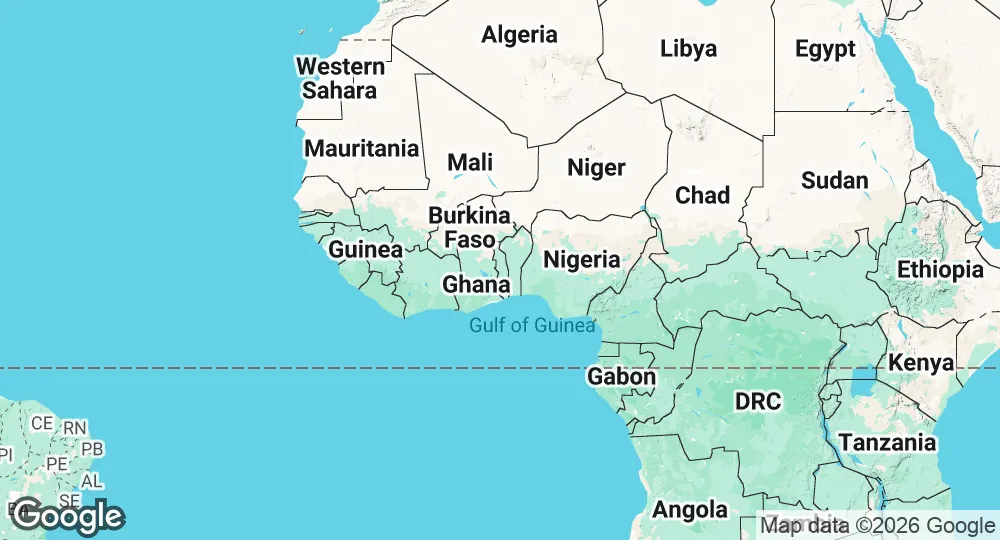
Togo is situated on the Gulf of Guinea in West Africa, bordered by Ghana to the west, Benin to the east, and Burkina Faso to the north. The primary security concern for the Togolese state is the southward spillover of extremist violence from the Sahel, specifically targeting the northern Savanes region. Since 2018, the Togolese Armed Forces (FAT) have maintained Operation Koundjoaré, a permanent military deployment in the north designed to prevent infiltration by groups such as Jama'at Nusrat al-Islam wal-Muslimin (JNIM).
Togo is a member of the Economic Community of West African States (ECOWAS) and the Accra Initiative, a regional security framework focused on intelligence sharing and joint cross-border operations. However, the defense posture shifted in 2025 toward a policy of diplomatic diversification. This included the ratification of a comprehensive military cooperation agreement with the Russian Federation in October 2025. The agreement covers joint exercises, officer training, and intelligence sharing. Additionally, the government has engaged in discussions regarding potential cooperation with the Alliance of Sahel States (AES), a move that would provide the landlocked members of that bloc access to the deep-water Port of Lomé.
Lomé maintains traditional security ties with France and the United States, but the current strategic doctrine emphasizes "cooperation without dependency." This involves balancing Western technical assistance with acquisitions and training from Turkey and Russia to enhance strategic autonomy.
Military Forces
The Forces Armées Togolaises (FAT) consist of the Army, Navy, Air Force, and the National Gendarmerie. The military is under the authority of the President, who also serves as the Minister of Defense. The National Gendarmerie, while under the Ministry of the Armed Forces, performs internal security, border enforcement, and migration duties.
Total active-duty personnel are estimated at 15,000, with a government mandate established to expand the force to 20,000. Women comprise approximately 7% of the personnel.
The Army is the largest branch and is structured for motorized infantry operations and counter-insurgency. Its equipment includes armored reconnaissance vehicles like the AML-90 and EE-9 Cascavel, alongside various armored personnel carriers such as the Bastion and Mamba. The branch prioritizes mobility and small-unit tactics to secure the northern border areas.
The Air Force operates from bases in Lomé and Niamtougou. The fleet includes refurbished Alpha Jet trainers and a variety of helicopters, including Russian-made Mi-17 transports and Mi-35M attack helicopters. A major shift in aerial capability occurred with the integration of Bayraktar TB2 unmanned combat aerial vehicles (UCAVs) of Turkish origin, which provide reconnaissance and strike capabilities in the Savanes region.
The Navy is focused on coastal patrol and maritime security in the Gulf of Guinea. It operates a fleet of patrol boats, including RPB-33 and Defender-class vessels, primarily tasked with counter-piracy and monitoring the country’s 56-kilometer coastline.
Strategic Trends
Defense policy is currently guided by the Military Programming Law (Loi de programmation militaire), which outlines modernization and procurement priorities. The government approved a draft budget for 2026 that represents a 14% increase over 2025, with specific allocations earmarked for national protection and the stabilization of northern territories. Military spending is estimated at approximately 2-4% of GDP.
Current modernization efforts focus on improving infrastructure and troop welfare in the north. In early 2025, the military high command was directed to upgrade forward operating bases in Kpendjal, Tône, and Cinkassé to better withstand insurgent attacks. Technical assistance from Russian military advisers, reported to be active in camp construction and training since 2024, is expected to continue following the opening of reciprocal embassies in 2026.
Constraints on the military include the logistical challenge of maintaining a diverse inventory of equipment from multiple suppliers, including France, Russia, Turkey, and Brazil. Additionally, the military faces the dual pressure of maintaining traditional regional commitments within ECOWAS while exploring ties with the rival AES bloc, creating a complex environment for regional interoperability.
Military Expenditure: CIA World Factbook. Last updated on 4 August 2026. Suggest a change
Frequently Asked Questions
How large is Togo's military?
What is Togo's defense budget?
How does Togo rank militarily in the world?
Does Togo have nuclear weapons?
How many aircraft does Togo's air force have?
How many tanks does Togo have?
What percentage of GDP does Togo spend on defense?
What is Togo's military personnel per capita?
Does Togo have paramilitary forces?
- AUG 42026 Updated Global Military Index updated in a site-wide editorial pass
- JUL 162026 Updated Global Military Index updated in a site-wide editorial pass
- JUN 162026 Updated Yearly statistics, military spending and 2 more fields updated
- MAR 172026 Updated Paramilitary personnel updated
- JAN 172026 Updated Main battle tank count added; Global Military Index updated
- JAN 132026 Updated Description added