Mi-17 Hip-H
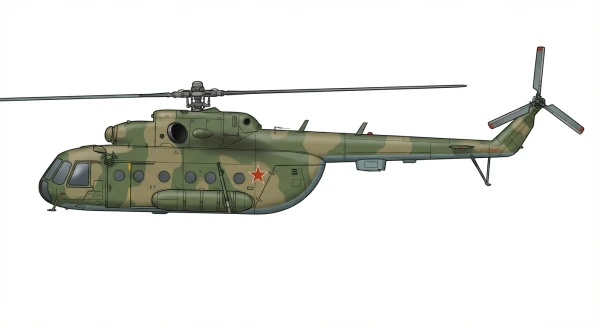
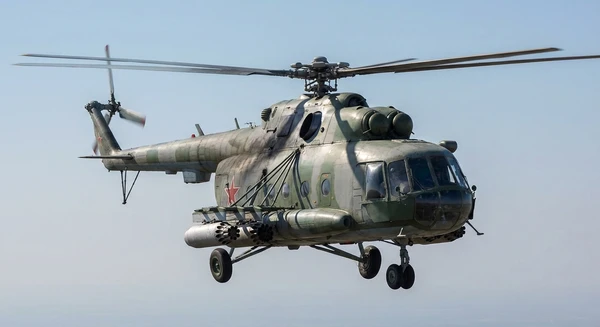
Soviet transport helicopter, prominently deployed during Afghan War, globally used for cargo, troop transport, and rescue missions. Key figures: top speed 250 km/h, range 800 km, service ceiling 6,000 m, max takeoff weight 13,000 kg, unit price $15M, built 12,000. In service with 36 air forces as of 2026 — China (234), India (222), Bangladesh (40) and 33 others.
| Crew | 3 |
| Length | 18.5 m (60.6 ft) |
| Wingspan | 21.3 m (69.7 ft) |
| Height | 4.8 m (15.6 ft) |
| Empty weight | 7,489 kg (16,510 lbs) |
| Max. takeoff weight | 13,000 kg (28,660 lbs) |
| Powerplant | 2 × turboshafts Klimov TV3-117VM 1,491 kW each |
| Maximum speed | 250 km/h (155 mph) |
| Operational range | 800 km (497 mi) |
| Service ceiling | 6,000 m (19,685 ft) |
| Climb rate | 8.0 m/s (26.2 ft/s) |
-
 China
234
China
234
-
 India
222
India
222
-
 Bangladesh
40
Bangladesh
40
-
 Iran
30
Iran
30
-
 Venezuela
28
Venezuela
28
-
 Czechia
20
Czechia
20
-
 Colombia
17
Colombia
17
- 🇱🇦 Laos 17
-
 Mexico
15
Mexico
15
-
 Turkmenistan
15
Turkmenistan
15
-
 Rwanda
12
Rwanda
12
-
 Croatia
10
Croatia
10
-
 Peru
10
Peru
10
-
 Slovakia
10
Slovakia
10
-
 Uganda
10
Uganda
10
-
 Indonesia
9
Indonesia
9
-
 Cuba
7
Cuba
7
-
 Ecuador
7
Ecuador
7
- 🇸🇸 South Sudan 7
-
 Eritrea
6
Eritrea
6
-
 Mongolia
6
Mongolia
6
-
 Nigeria
6
Nigeria
6
-
 Nepal
6
Nepal
6
-
 Cameroon
5
Cameroon
5
-
 Ghana
5
Ghana
5
-
 Myanmar
5
Myanmar
5
-
 Zambia
5
Zambia
5
-
 Senegal
4
Senegal
4
-
 Bulgaria
2
Bulgaria
2
-
 Guinea
2
Guinea
2
-
 Kenya
2
Kenya
2
-
 Niger
2
Niger
2
- 🇬🇶 Equatorial Guinea 1
-
 Sierra Leone
1
Sierra Leone
1
-
 United States
1
United States
1
-
 Zimbabwe
1
Zimbabwe
1
Recent Events — Mi-17 Hip-H
14 events →-
AUG 92026
 Niger
×2
Two Mi-171 received from Algeria at Niamey airport, with type-specific ammunition and spare parts.
Delivered
Niger
×2
Two Mi-171 received from Algeria at Niamey airport, with type-specific ammunition and spare parts.
Delivered
-
MAY 42026
 Mexico
Mi-17 suffered engine power failure seconds after takeoff from Fourth Naval Region base in Mazatlán; nose landing gear broken in forced landing, no casualties.
Damaged
Mexico
Mi-17 suffered engine power failure seconds after takeoff from Fourth Naval Region base in Mazatlán; nose landing gear broken in forced landing, no casualties.
Damaged
-
APR 72026
 Iran
×3
Three IRGC Mi-17V-5/Mi-171E helicopters destroyed at Fat'h Heliport in Karaj by Israeli Delilah cruise missile strike; satellite imagery later confirmed at least four airframes hit, one already non-operational.
Destroyed
Iran
×3
Three IRGC Mi-17V-5/Mi-171E helicopters destroyed at Fat'h Heliport in Karaj by Israeli Delilah cruise missile strike; satellite imagery later confirmed at least four airframes hit, one already non-operational.
Destroyed
-
APR 62026
Iran
×2
Two Mi-8/17 transport helicopters destroyed at Mehrabad Airport by Israeli airstrikes; IDF released strike footage confirming destruction.
Destroyed
-
MAR 182026
Iran
Mi-17 helicopter destroyed on ground at Sanandaj Airport by Israeli airstrike; IDF released strike footage.
Destroyed
Description
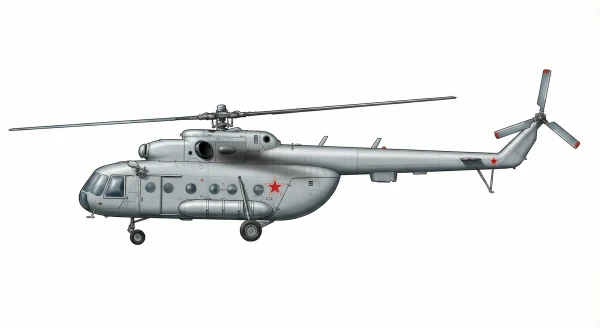
The Mil Mi-17 (NATO reporting name Hip-H) is a Soviet-designed Russian medium twin-turbine transport helicopter and armed gunship produced in Kazan and Ulan-Ude. Introduced in 1975 as the Mi-8M series, the type is designated Mi-8MT in Russian military service and Mi-17 for export. It is recognized as one of the most widely operated military helicopters in history, serving troop transport, armed support, and specialized utility roles.
Development
Developed from the Mi-8 airframe, the Mi-17 incorporated Klimov TV3-117MT engines, rotors, and transmission from the Mi-14, along with fuselage modifications for heavier loads. Production began in the Soviet Union and continues in Russia, with licensed manufacturing also established in China by Sichuan Lantian Helicopter Company. Major milestones include an Indian contract for 151 Mi-17V-5 helicopters delivered by 2016 and local assembly kit agreements with Kazakhstan. Engine upgrades over time include the TV3-117VM for high-altitude operations and the FADEC-controlled Klimov VK-2500.
Design
The Mi-17 is distinguished from the Mi-8 by a port-side tail rotor, dust shields on engine intakes, shorter engine cowls, and a bleed air valve outlet forward of the exhaust. Powered by engines such as the Klimov VK-2500PS-03 rated at 1,800 kW, it reaches a maximum speed of 280 km/h and a service ceiling of 6,000 meters. Depending on variant, construction features include Kevlar cockpit armor, a dolphin nose, and a hydraulic loading ramp replacing clamshell doors. Avionics and specialized systems include Doppler and weather radars, FLIR turrets, night-vision-compatible cockpit lighting, and active protection systems.
Armament
Armed variants utilize up to six external hardpoints mounted on lateral stores racks. The helicopter carries unguided S-5 and S-8 rocket pods, UPK-23-250 gun pods, anti-tank guided missiles such as the 9M120 Ataka and Spike, drop tanks, and up to 4,000 kg of bombs. Defense is provided by one or two window-mounted PK machine guns. Internal payload capacity is 4,000 kg or 24 troops, with an external slung load capacity of 5,000 kg.
Operational History
Combat deployments include government offensives in Cambodia, the Sri Lankan Civil War, the 1999 Kargil War, Operation Enduring Freedom in Afghanistan, and the Russian invasion of Ukraine. Missions range from armed assault and troop transport to anti-narcotics operations in Mexico and disaster relief in India and Thailand. Major operators and export customers include India, China, Thailand, Pakistan, Peru, Belarus, and the United States for allied forces.
Variants
-
Mi-8MT: The basic updated Soviet military transport version powered by Klimov TV3-117MT engines, designated Mi-17 for export.
-
Mi-8MTV-5: A military utility transport variant featuring Klimov TV3-117VM engines, a modified dolphin nose, and a rear loading ramp.
-
Mi-8AMTSh: An armed assault variant equipped with targeting systems, guided anti-tank missiles, unguided rockets, and active defense systems.
-
Mi-171E: An export variant equipped with VK-2500-03 engines designed for extreme temperature operations between -58°C and 50°C.
-
Mi-171A2: A modernized civilian transport model incorporating Klimov VK-2500PS-03 engines and upgraded digital flight systems.
Identified in 3 sorties in the official China-Taiwan Tensions activity reports between 2021 and 2022 — a floor, not a census: only sorties the source identified by type are counted, and how much it disclosed varies by year.
Frequently Asked Questions
What type of aircraft is the Mi-17 Hip-H?
What is the maximum speed of the Mi-17 Hip-H?
What is the range of the Mi-17 Hip-H?
When did the Mi-17 Hip-H first fly?
How many Mi-17 Hip-H have been built?
Which countries operate the Mi-17 Hip-H?
How much does a Mi-17 Hip-H cost?
What is the service ceiling of the Mi-17 Hip-H?
- AUG 62026 Updated Description updated
- AUG 52026 Updated Powerplant updated in a site-wide editorial pass
- APR 72026 Updated Sources and cross-references refreshed
- MAR 172026 Updated Description updated
- FEB 72026 Updated Mi-17 Hip-H: range added; Mi-17 Hip-H: wingspan added