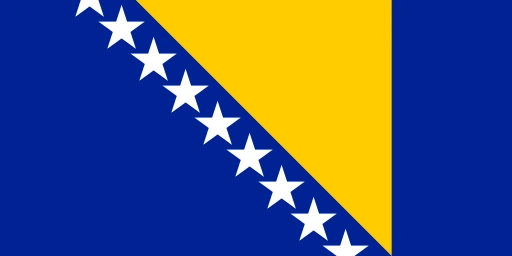
Flag of Bosnia and Herzegovina
Overview
| Country | Bosnia and Herzegovina |
| Adopted | 1998 |
| Aspect ratio | 1:2 |
| Colors | |
| Elements | Stars, triangle |
Description
A wide medium blue field is characterized by a yellow right-angled triangle positioned with its base at the top and its vertical side on the right. Running along the hypotenuse of this triangle is a diagonal line of seven full white five-pointed stars and two partial stars at the edges. This composition follows a 1:2 aspect ratio, where the stars are arranged to appear as if they continue beyond the hoist and fly boundaries.
Symbolism
The three vertices of the yellow triangle are intended to represent the three constituent ethnic groups of the nation: Bosniaks, Croats, and Serbs. Additionally, the triangular shape mirrors the actual geographic map of Bosnia and Herzegovina. Blue and white colors, combined with the celestial motifs, were selected to align with the aesthetics of the Council of Europe and signify a desire for European integration. The truncated stars at the top and bottom suggest an infinite sequence, symbolizing a continuous path toward the future and stability.
History
Adopted on February 4, 1998, this design replaced the previous white flag featuring the blue-and-gold Kotromanić shield used during the 1992–1998 period. High Representative Carlos Westendorp introduced the current version after the country's multi-ethnic parliament could not agree on a unified national symbol. Earlier, as part of Yugoslavia, the region utilized a red banner with a small Yugoslav tricolor in the canton. The 1998 transition was specifically managed by the international community to move away from symbols associated with specific ethnic groups.