Flag of the Central African Republic
Overview
| Country | Central African Republic |
| Adopted | 1958 |
| Aspect ratio | 3:5 |
| Colors | |
| Elements | Stars, vertical stripes |
Description
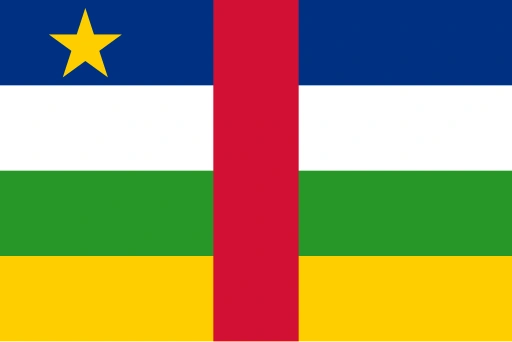
Four horizontal bands of blue, white, green, and yellow are intersected by a single vertical red stripe positioned in the center. A five-pointed yellow star is located in the canton, placed within the uppermost blue band. This design maintains a standard aspect ratio of 3:5.
Symbolism
Combining the French tricolour with Pan-African colors, the design signifies a shared future between Europe and Africa. The red vertical stripe represents the blood of the nation and the common humanity of all people, while the yellow star serves as a guide for progress and unity. Blue and white represent liberty and peace respectively, whereas green symbolizes hope and yellow denotes tolerance.
History
President Barthélemy Boganda designed the flag, which was officially adopted on December 1, 1958, for the then-autonomous territory of Ubangi-Shari. It was intended to symbolize a union between France and its African colonies during the transition toward full independence. Unlike many neighboring nations, the Central African Republic has retained this specific design through multiple constitutional changes and the brief period of the Central African Empire.