Central African Republic Military Forces
Open-source order of battle for 2026: 9,150 active troops, 8 aircraft.

Armed Forces in 2026
| Domain | Strength | Composition |
|---|---|---|
| Central African Republic Air Force | 8 aircraft | |
| Ground Forces | 4 tanks | |
| Personnel | 9,150 active | 8,000 paramilitary |
Global Military Index
Full ranking →| Pillar | Weight | Score | Basis |
|---|---|---|---|
| Manpower | 15% | 47.3 | Active, reserve & paramilitary personnel |
| Ground forces | 20% | 20.1 | Tanks, armor & artillery weighted by type |
| Naval power | 20% | 0.0 | Weighted by hull type: carrier tiers, nuclear vs conventional submarines |
| Air power | 25% | 3.2 | Weighted by aircraft type and fleet age |
| Nuclear deterrent | 10% | 0.0 | No declared nuclear capability |
| Defense budget | 10% | 15.3 | Annual spending, purchasing-power adjusted |
| Readiness | modifier | ×0.89 | Budget per soldier: proxy for training, maintenance & technology |
Country File
| Population | 5.3M (2024) |
| GDP | $2.8 billion (2024) |
| GDP per capita | $516 |
| Military budget | $68.8 million (2024) |
| Share of GDP | 2.5% (2024) |
| Military spending per capita | $13 (2024) |
| Inflation rate | 1.48% (2024) |
| Capital | Bangui |
| Region | Africa |
| Land area | 622,984 km² |
| Land borders | 5,213 km |
| Bordering countries | 6 |
| Currency | XAF |
| Aspect ratio | 3:5 |
| Colors | Red, blue, green, yellow, white |
Strategic Overview in 2026
Strategic Position
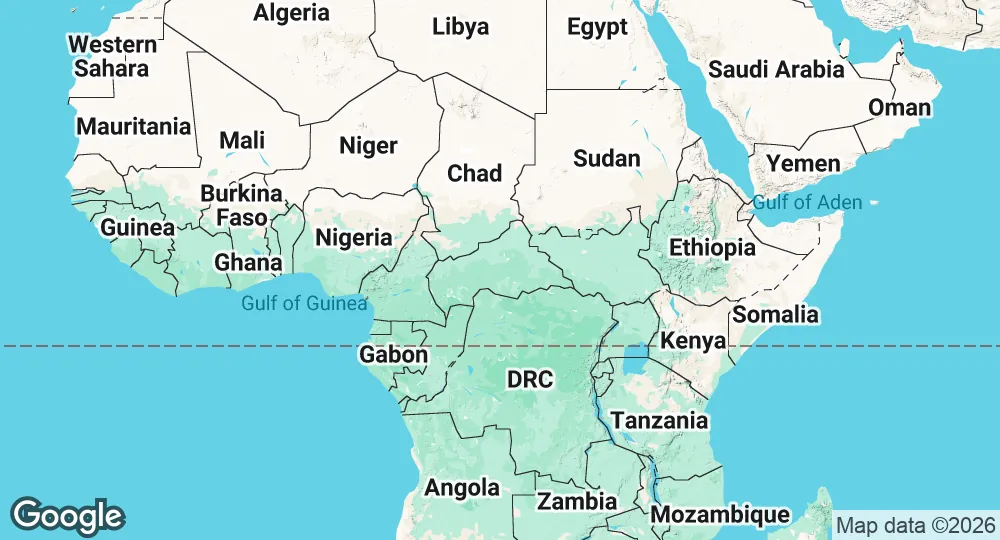
The Central African Republic (CAR) occupies a landlocked position in Central Africa, sharing borders with Chad, Sudan, South Sudan, the Democratic Republic of the Congo, the Republic of the Congo, and Cameroon. The primary security concern remains the preservation of territorial integrity against a fragmented landscape of non-state armed groups, specifically the Coalition des patriotes pour le changement (CPC). These groups maintain control over various rural regions and transit corridors, challenging the central government's authority.
National defense doctrine has shifted toward a multi-partner security architecture following the phased withdrawal of French forces. The government maintains a bilateral defense agreement with the Russian Federation, which provides personnel for training and operational support under the framework of the Africa Corps (formerly Wagner Group). Simultaneously, CAR maintains a bilateral security agreement with Rwanda, involving both combat and protection units separate from multilateral missions.
The United Nations Multidimensional Integrated Stabilization Mission in the Central African Republic (MINUSCA) remains a primary component of the security landscape. Regional relationships are influenced by border insecurity, particularly in the northeast where the civil war in Sudan has led to refugee influxes and cross-border movements of armed elements. CAR is a member of the Economic Community of Central African States (ECCAS), though its primary security reliance is on bilateral rather than regional pacts.
Military Forces
The Forces Armées Centrafricaines (FACA) is the primary state military organization, under the command of the Ministry of National Defense and Reconstruction of the Army. The military is organized into the Army, the Air Force, and the National Gendarmerie. Total active personnel are estimated at approximately 12,000.
The Army is the dominant branch, structured into territorial defense zones. Its units primarily consist of light infantry, with a small number of mechanized and armored elements. The Republican Guard (GR) functions as an elite force tasked with the protection of high-level officials and the capital, Bangui. Foreign instructors from the Russian Federation and Rwanda provide training at facilities such as the Berengo camp.
Military equipment consists largely of Soviet-era systems and recent deliveries from partner nations. The Army operates:
-
Armored scout cars, including BRDM-2 models.
-
Armored personnel carriers, primarily BTR-70 and BTR-80 variants.
-
High-mobility multipurpose vehicles and "technicals" equipped with heavy machine guns or anti-aircraft cannons.
-
T-54/55 main battle tanks, though operational status is inconsistent across the fleet.
The Air Force possesses limited capabilities and focuses on transport, reconnaissance, and light ground attack. It operates:
-
L-39 Albatros jet trainers utilized in a light attack role.
-
Mi-24 Hind attack helicopters.
-
Light utility and transport aircraft, including Cessna and Antonov models.
The National Gendarmerie and the National Police function as paramilitary forces responsible for internal security, border patrol, and public order in government-controlled urban centers.
Strategic Trends
The lifting of the United Nations arms embargo in July 2024 has enabled a transition in procurement and modernization. The government is currently prioritizing the acquisition of modern small arms, communications equipment, and light armored vehicles to improve the mobility of infantry units in the hinterland.
Defense spending is estimated at approximately 2% to 3% of GDP, though a significant portion of security costs is offset by bilateral support and the presence of international missions. Strategic priorities for 2025 and 2026 focus on the "professionalization" of the FACA, seeking to integrate former rebels under Disarmament, Demobilization, and Reintegration (DDR) programs while expanding the state's physical presence in mining regions and along the Sudanese border.
The integration of Russian personnel into the Africa Corps structure under the formal oversight of the Russian Ministry of Defense marks a shift toward more formalized state-to-state military cooperation. This relationship focuses on training FACA units and providing tactical air support during counter-insurgency operations.
Constraints facing the military include limited logistical reach, a lack of indigenous maintenance capabilities for complex platforms, and the continued presence of decentralized armed groups that employ asymmetric tactics. Future force structure shifts are expected to emphasize specialized counter-terrorism units and the expansion of the Air Force's rotary-wing fleet to improve medical evacuation and rapid reinforcement capabilities.
Frequently Asked Questions
How large is Central African Republic's military?
What is Central African Republic's defense budget?
How does Central African Republic rank militarily in the world?
Does Central African Republic have nuclear weapons?
How many aircraft does Central African Republic's air force have?
How many tanks does Central African Republic have?
What percentage of GDP does Central African Republic spend on defense?
What is Central African Republic's military personnel per capita?
Does Central African Republic have paramilitary forces?
Military Expenditure: CIA World Factbook. Suggest a change