Flag of the Gambia
Overview
| Country | Gambia |
| Adopted | 1965 |
| Aspect ratio | 2:3 |
| Colors | |
| Elements | Horizontal stripes |
Description
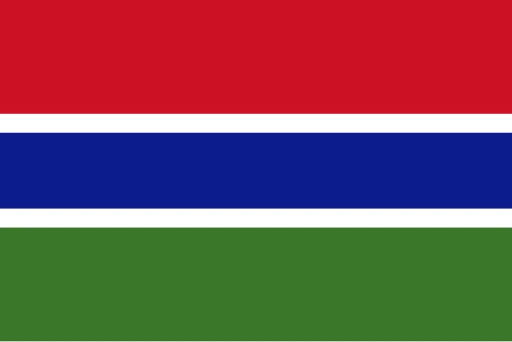
This national flag features five horizontal bands of red, blue, and green, separated by two thin white stripes. The three primary colored bands are of equal thickness, while the white fimbriations are significantly narrower. No additional symbols or emblems appear on the field.
Symbolism
The top red stripe represents the sun and the savanna, while the bottom green stripe signifies the country's agriculture and natural vegetation. Central to the design is a blue band that symbolizes the Gambia River, the nation's primary geographical feature. The white fimbriations bordering the blue stripe denote peace, purity, and the unity of the Gambian people.
History
The current design was officially adopted on February 18, 1965, to coincide with the nation's independence from British colonial rule. It replaced the British Blue Ensign which had featured a circular badge depicting an elephant and a palm tree. Louis Thomasi is credited with creating the design, which has remained unchanged through the country's transition to a republic in 1970.