Gambia Military Forces
Open-source order of battle for 2026: 800 active troops, 1 aircraft.
Armed Forces in 2026
| Domain | Strength | Composition |
|---|---|---|
| Air Force | 1 aircraft | 1 combat |
| Personnel | 800 active |
ARMS Index (Aggregate Rating of Military Strength)
Full ranking →| Pillar | Weight | Score | Basis |
|---|---|---|---|
| Manpower | 15% | 27.6 | Active, reserve & paramilitary personnel |
| Ground forces | 20% | 0.0 | Tanks, armor & artillery weighted by type |
| Naval power | 20% | 0.0 | Weighted by hull type: carrier tiers, nuclear vs conventional submarines |
| Air power | 25% | 7.9 | Weighted by aircraft type and fleet age |
| Nuclear deterrent | 10% | 0.0 | No declared nuclear capability |
| Defense budget | 10% | 7.6 | Annual spending, purchasing-power adjusted |
| Readiness | modifier | ×0.95 | Budget per soldier: proxy for training, maintenance & technology |
Country File
| Population | 2.8M (2024) |
| GDP | $2.4 billion (2024) |
| GDP per capita | $871 |
| Military budget | $14M (2024) |
| Share of GDP | 0.6% (2024) |
| Military spending per capita | $5 (2024) |
| Inflation rate | 11.56% (2024) |
| Capital | Banjul |
| Region | Africa |
| Land area | 10,000 km² |
| Coastline | 80 km |
| Land borders | 740 km |
| Bordering countries | 1 |
| Currency | GMD |
Strategic Overview in 2026
Strategic Position
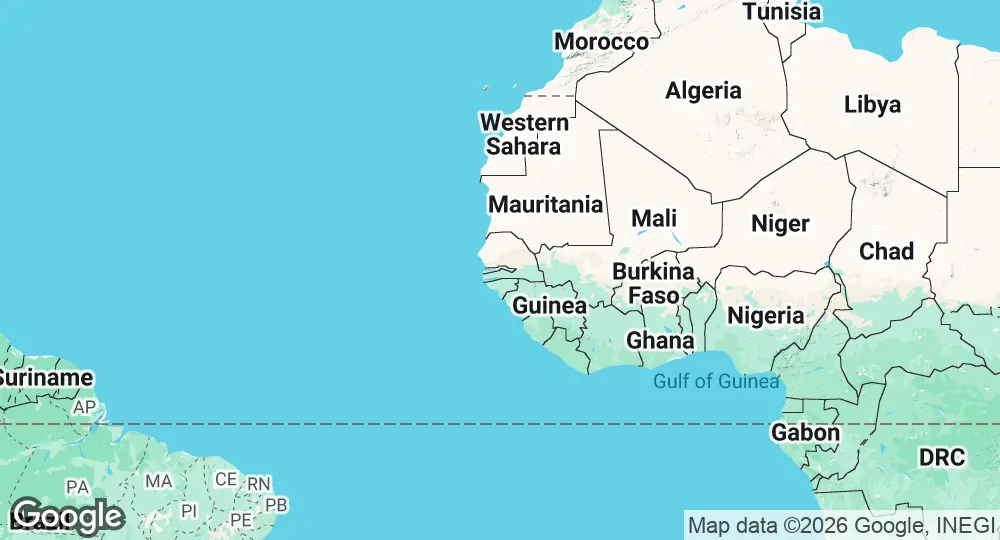
The Gambia’s defense posture is defined by its unique geography as an enclave within Senegal, with which it maintains a complex security relationship. Primary security concerns center on internal stability, border management, and the protection of maritime resources against illegal, unreported, and unregulated (IUU) fishing. Since the 2017 political transition, the country has relied heavily on the Economic Community of West African States (ECOWAS) Mission in The Gambia (ECOMIG) to maintain order and provide a security buffer. In June 2025, the ECOWAS Authority of Heads of State and Government extended the ECOMIG mandate for a further 24 months, designated as a final extension to allow for the completion of domestic security reforms.
Gambia is a member of the African Union (AU) and ECOWAS, and its defense doctrine is increasingly aligned with regional collective security frameworks. Bilateral defense cooperation is most prominent with Turkey, which serves as a primary partner for military training and equipment. Additionally, the United Kingdom, United States, and China provide varied levels of support in professional military education, maritime security training, and infrastructure development. Relationships with Senegal are governed by several security protocols, though occasional tensions persist regarding border demarcations and the transit of goods.
Military Forces
The Gambia Armed Forces (GAF) are organized into three primary branches: the Gambia National Army (GNA), the Gambia Navy, and the Republican National Guard (RNG). The President serves as the Commander-in-Chief, with operational control exercised by the Chief of Defence Staff. As of 2025, the GAF maintains an active strength of approximately 4,000 personnel, supplemented by a reserve force of roughly 1,000 and paramilitary elements including the Police Intervention Unit.
The Gambia National Army is the largest branch and functions primarily as a light infantry force. Its equipment profile consists of light tactical vehicles, technicals, and armored personnel carriers. In January 2025, the army integrated 17 Turkish-manufactured Cobra-1 armored personnel carriers into its inventory to support peacekeeping and domestic security operations. The army lacks main battle tanks and heavy tube artillery, focusing instead on mobile, small-unit tactics.
The Gambia Navy operates a limited fleet of coastal patrol boats tasked with enforcing fishery legislation and maritime border control. Capability is concentrated in small, high-speed interceptors and patrol craft often donated or supported by international partners such as Turkey, China, and the United States. The Navy utilizes the Maritime Security and Safety Information System (MSSIS) for regional coastal surveillance.
The Republican National Guard serves as a specialized force responsible for presidential protection, the security of high-level state infrastructure, and anti-riot duties. While an "Air Wing" or "Air Force" is formally part of the military structure, it possesses no combat aircraft and maintains only a negligible inventory of small utility aircraft or rotary-wing assets for transport and training.
Strategic Trends
The primary focus of Gambian defense policy is the 2023–2027 Security Sector Reform (SSR) Strategy. This program aims to professionalize the GAF, establish clear civilian oversight, and transition primary internal security responsibilities from ECOMIG to domestic forces. Implementation of the SSR involves legislative reviews of the Armed Forces Act and the development of new policies on gender and human rights within the military.
Modernization efforts are largely dependent on foreign assistance. The partnership with Turkey remains central, encompassing the graduation of hundreds of Gambian personnel from Turkish military academies and the periodic handover of hardware. Defense spending is low by regional standards, estimated at approximately 0.6% of GDP, which necessitates a reliance on external funding for major procurement and infrastructure projects.
The military faces significant structural constraints, including limited fiscal space for maintenance and personnel welfare. Reports in 2025 noted challenges related to the retention of specialized personnel and the need to harmonize various "camps" or factions within the officer corps that emerged during previous political eras. The force remains oriented toward international peacekeeping, frequently contributing personnel to United Nations and ECOWAS missions to gain operational experience and supplemental funding.
Military Expenditure: CIA World Factbook. Last updated on 4 August 2026. Suggest a change
Frequently Asked Questions
How large is Gambia's military?
What is Gambia's defense budget?
How does Gambia rank militarily in the world?
Does Gambia have nuclear weapons?
How many aircraft does Gambia's air force have?
What percentage of GDP does Gambia spend on defense?
What is Gambia's military personnel per capita?
- AUG 42026 Updated Global Military Index updated in a site-wide editorial pass
- JUL 162026 Updated Global Military Index updated in a site-wide editorial pass
- JUN 162026 Updated Yearly statistics and military spending share of GDP updated
- JAN 132026 Updated Description added