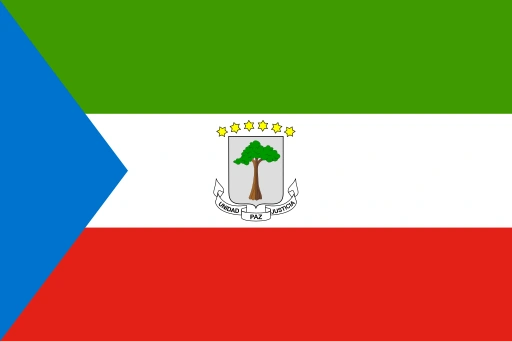
Flag of Equatorial Guinea
Overview
| Country | Equatorial Guinea |
| Adopted | 1979 |
| Aspect ratio | 2:3 |
| Colors | |
| Elements | Horizontal stripes, triangle, coat of arms |
Description
This national flag consists of three horizontal stripes in green, white, and red, with a blue isosceles triangle situated at the hoist. Centered on the middle white stripe is the national coat of arms, which features a silk cotton tree beneath six six-pointed yellow stars. The design is executed in a standard 2:3 aspect ratio.
Symbolism
The green stripe symbolizes the nation's vast natural resources and agriculture, while white represents peace and red signifies the blood shed during the struggle for independence. Positioned at the hoist, the blue triangle denotes the Atlantic Ocean, which links the mainland territory to the country's various islands. The six stars on the coat of arms represent the mainland and the five offshore islands, while the silk cotton tree commemorates the 1843 treaty signed between local rulers and Spain.
History
Equatorial Guinea first adopted this flag design upon achieving independence from Spain on October 12, 1968. During the presidency of Francisco Macías Nguema between 1972 and 1979, the national emblem in the center was modified to reflect the specific symbols of his regime. Following the 1979 coup led by Teodoro Obiang Nguema Mbasogo, the original coat of arms was officially reinstated on August 21. This restoration returned the flag to its primary post-colonial configuration, which has remained unchanged ever since.