Equatorial Guinea Military Forces
Open-source order of battle for 2026: 2,400 active troops, 27 aircraft.
Armed Forces in 2026
| Domain | Strength | Composition |
|---|---|---|
| Air Force | 27 aircraft | 4 combat 13 helicopters |
| Ground Forces | 3 tanks | |
| Personnel | 2,400 active |
Global Military Index
Full ranking →| Pillar | Weight | Score | Basis |
|---|---|---|---|
| Manpower | 15% | 35.2 | Active, reserve & paramilitary personnel |
| Ground forces | 20% | 18.2 | Tanks, armor & artillery weighted by type |
| Naval power | 20% | 0.0 | Weighted by hull type: carrier tiers, nuclear vs conventional submarines |
| Air power | 25% | 22.7 | Weighted by aircraft type and fleet age |
| Nuclear deterrent | 10% | 0.0 | No declared nuclear capability |
| Defense budget | 10% | 19.0 | Annual spending, purchasing-power adjusted |
| Readiness | modifier | ×1.02 | Budget per soldier: proxy for training, maintenance & technology |
Country File
| Population | 1.9M (2024) |
| GDP | $12.8 billion (2024) |
| GDP per capita | $6,745 |
| Military budget | $128M (2024) |
| Share of GDP | 1.0% (2024) |
| Military spending per capita | $67 (2024) |
| Inflation rate | 2.92% (2024) |
| Capital | Malabo |
| Region | Africa |
| Land area | 28,051 km² |
| Coastline | 296 km |
| Land borders | 539 km |
| Bordering countries | 2 |
| Currency | XAF |
Strategic Overview in 2026
Strategic Position
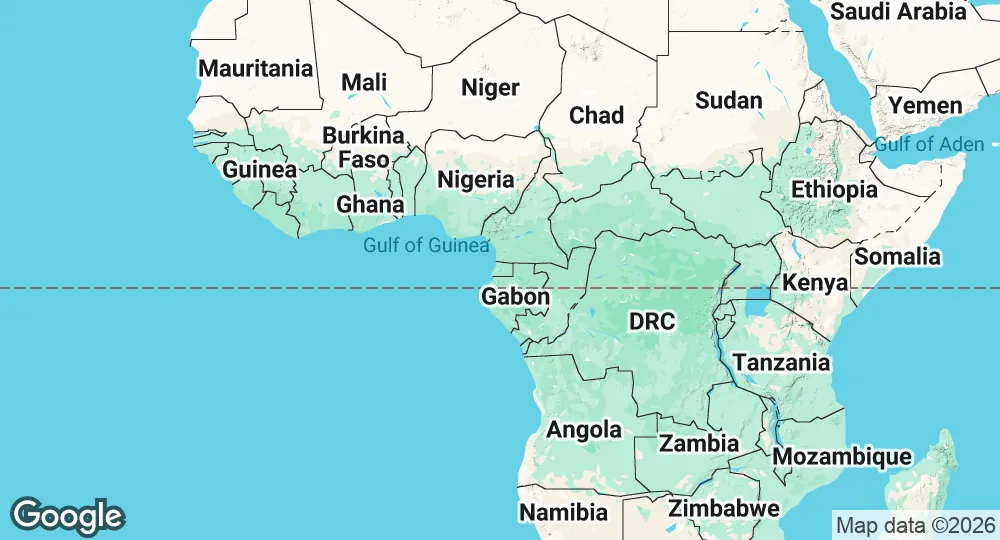
Equatorial Guinea occupies a central position in the Gulf of Guinea, a region defined by substantial offshore hydrocarbon reserves and persistent maritime security threats, including piracy and illicit trafficking. National defense priorities center on the protection of oil and gas infrastructure, which provides the primary basis for the state's economy. The military posture is fundamentally defensive, focused on maintaining territorial integrity and maritime sovereignty.
Regionally, Equatorial Guinea is a member of the Economic Community of Central African States (ECCAS) and participates in the Maritime Organization for West and Central Africa. A long-standing territorial dispute with Gabon persists over the sovereignty of Mbanie, Cocotiers, and Conga islands, located in a potentially oil-rich maritime zone. While both nations have sought international mediation, the dispute necessitates a constant naval and gendarmerie presence in the Corisco Bay area.
Equatorial Guinea maintains diverse bilateral security relationships to offset limited domestic capabilities. Israel provides specialized training and equipment for presidential security and elite units. China is a primary supplier of hardware and has expressed strategic interest in developing naval logistics facilities in Bata. Russia has expanded its presence through the Africa Corps initiative, deploying personnel to assist in elite guard training and internal security operations.
Military Forces
The Armed Forces of Equatorial Guinea (Fuerzas Armadas de Guinea Ecuatorial) are organized into the Army, Navy, Air Force, and the National Gendarmerie. Command is highly centralized under the President, who serves as Commander-in-Chief. Total active personnel are estimated at approximately 3,000, supplemented by approximately 2,000 Gendarmerie personnel.
Army The Army is the largest branch and is structured for territorial defense and internal security. The inventory is transitioning from Soviet-era equipment to Chinese-manufactured platforms. The force operates T-55 main battle tanks and BMP-1 infantry fighting vehicles. Recent acquisitions include WMA301 wheeled assault guns and WZ-551 armored personnel carriers. Specialized units include a presidential guard traditionally supported by foreign contractors or advisors.
Navy The Navy (Marina de Guerra) is the most modern branch, optimized for coastal patrol and offshore asset protection. Its flagship is the frigate Bata, supported by the Wele Nzas corvette, the latter of which was integrated at the Malabo dry dock. The fleet operates several Shaldag-class fast patrol boats and Bulgarian-built PV-50M patrol craft. Naval operations are coordinated from bases in Malabo and Bata, focusing on anti-piracy and maritime domain awareness.
Air Force The Air Force operates a small inventory of fixed-wing and rotary-wing aircraft. Combat capabilities are centered on Su-25 ground attack aircraft and L-39 Albatros trainers. The transport fleet includes An-72 and CASA C-295 aircraft. The rotary-wing component consists of Mi-24/35 attack helicopters and recently delivered Z-9WE armed helicopters from China, equipped with electro-optical sensors and weapon pylons.
Gendarmerie The National Gendarmerie functions as a paramilitary internal security force. It maintains a presence across the mainland and islands, often working in conjunction with the Army to secure border regions and critical infrastructure.
Defense Industry
Equatorial Guinea lacks a broad domestic arms manufacturing sector and remains almost entirely dependent on foreign imports for lethal equipment and advanced technology. Domestic activity is restricted to naval maintenance and integration. The Astilleros de Guinea Ecuatorial (ASGE) facility in Malabo has demonstrated the capability to perform final assembly and systems integration on naval hulls sourced from foreign shipyards, as evidenced by the commissioning of the Wele Nzas. The state relies on foreign contractors, primarily from Russia, China, and Israel, for the sustainment and overhaul of its armored vehicles and aircraft.
Strategic Trends
Defense expenditure is projected to remain stable at approximately $145 million annually through 2026, though actual spending remains closely tied to national hydrocarbon revenues. A primary strategic trend is the increasing reliance on Chinese military hardware and Russian security personnel. The deployment of approximately 200 Russian Africa Corps personnel represents a shift toward Eastern security partnerships for elite training and regime protection.
Modernization priorities are currently focused on enhancing maritime domain awareness and upgrading the Air Force’s rotary-wing fleet. Discussions with Chinese defense firms such as CATIC indicate an intent to procure advanced aeronautical sensors and patrol platforms. The military faces persistent constraints regarding technical self-sufficiency, often requiring foreign personnel for the operation and maintenance of sophisticated naval and aviation assets. Force professionalization remains a long-term priority, with personnel receiving training from a variety of international sources including the United States, France, and Zimbabwe.
Frequently Asked Questions
How large is Equatorial Guinea's military?
What is Equatorial Guinea's defense budget?
How does Equatorial Guinea rank militarily in the world?
Does Equatorial Guinea have nuclear weapons?
How many aircraft does Equatorial Guinea's air force have?
How many tanks does Equatorial Guinea have?
What percentage of GDP does Equatorial Guinea spend on defense?
What is Equatorial Guinea's military personnel per capita?
Military Expenditure: CIA World Factbook. Last updated on 4 August 2026. Suggest a change
- AUG 42026 Updated Global Military Index updated in a site-wide editorial pass
- JUL 162026 Updated Global Military Index updated in a site-wide editorial pass
- JUN 162026 Updated Yearly statistics, military spending and 2 more fields updated
- JAN 172026 Updated Main battle tank count added; Global Military Index updated
- JAN 132026 Updated Description added