Flag of Kazakhstan
Overview
| Country | Kazakhstan |
| Adopted | 1992 |
| Aspect ratio | 1:2 |
| Colors | |
| Elements | Eagle, sun |
Description
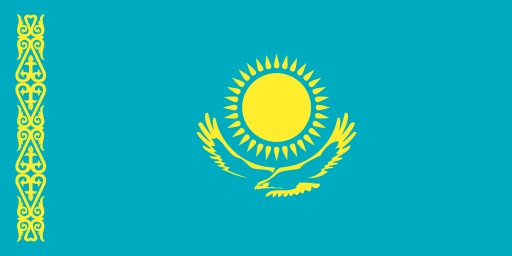
The national flag of Kazakhstan consists of a sky-blue field featuring a gold sun with 32 rays centered above a soaring steppe eagle. A vertical stripe of traditional gold ornamentation, known as 'koshkar-muiz', is positioned along the hoist side. All graphical elements are rendered in a uniform yellow-gold, contrasting against the solid blue background.
Symbolism
The sky-blue field represents the vastness of the heavens and serves as a traditional color of the Turkic peoples, symbolizing peace and well-being. At the center, the sun represents a source of life and energy, while the steppe eagle beneath it signifies the freedom, independence, and lofty goals of the Kazakh state. The golden 'koshkar-muiz' pattern on the left edge commemorates the ancient artistic traditions and cultural identity of the nation. Together, these elements reflect the transition of the republic into the modern era while maintaining its historical roots.
History
Following the dissolution of the Soviet Union, Kazakhstan officially adopted its current flag on June 4, 1992. The design was created by Shaken Niyazbekov, winning a competition that included over 600 proposals. Initially, the ornamental pattern on the hoist was colored red, but this was changed to gold in late 1992 to improve color consistency. This flag replaced the previous 1953 design of the Kazakh Soviet Socialist Republic, which featured a horizontal blue stripe and communist symbols on a red field.