Kazakhstan Military Forces
Kazakhstan ranks #54 of 170 militaries worldwide in 2026, with 39,000 active troops. The Kazakhstani Army fields 1,934 ground vehicles, including 350 main battle tanks; the Air Force flies 172 aircraft, including 54 combat aircraft; the Navy operates 7 warships. Landlocked, Kazakhstan has no navy and no nuclear weapons.
Armed Forces in 2026
| Domain | Strength | Composition |
|---|---|---|
| Kazakh Air Defense Forces | 172 aircraft | 54 combat 72 helicopters 2 air bases +9 on order |
| Kazakh Naval Forces | 7 warships | |
| Ground Forces | 1,934 vehicles | 350 main battle tanks |
| Personnel | 39,000 active | 31,500 paramilitary |
ATLAS Index (Aggregate Total of Land, Air and Sea strength)
Full ranking →| Pillar | Weight | Score | Basis |
|---|---|---|---|
| Manpower | 10% | 35.9 | Active, reserve & paramilitary personnel |
| Ground forces | 20% | 40.3 | ARMS inventory power: armour & artillery by type and era, attack helicopters, armament |
| Naval power | 20% | 17.7 | SEAS inventory power: hulls by type, size and era, air wing, sustainment, armament |
| Air power | 25% | 30.5 | AIRS inventory power: aircraft by type and generation, enablers, armament |
| Nuclear deterrent | 10% | 0.0 | No declared nuclear capability |
| Defense budget | 15% | 34.2 | Annual spending, purchasing-power adjusted |
| Availability | modifier | ground ×1.08 · naval ×1.20 · air ×1.07 | Budget per point of each force, from the branch indexes |
Country File
| Population | 20.8M (2025) |
| GDP | $306.2 billion (2025) |
| GDP per capita | $14,692 |
| Military budget | $2.6B (2024) |
| Share of GDP | 0.9% (2024) |
| Military spending per capita | $126 (2024) |
| Inflation rate | 11.39% (2025) |
| Capital | Astana |
| Region | Asia |
| Land area | 2,699,700 km² |
| Land borders | 12,012 km |
| Bordering countries | 5 |
| Currency | KZT |
Strategic Overview in 2026
Strategic Position
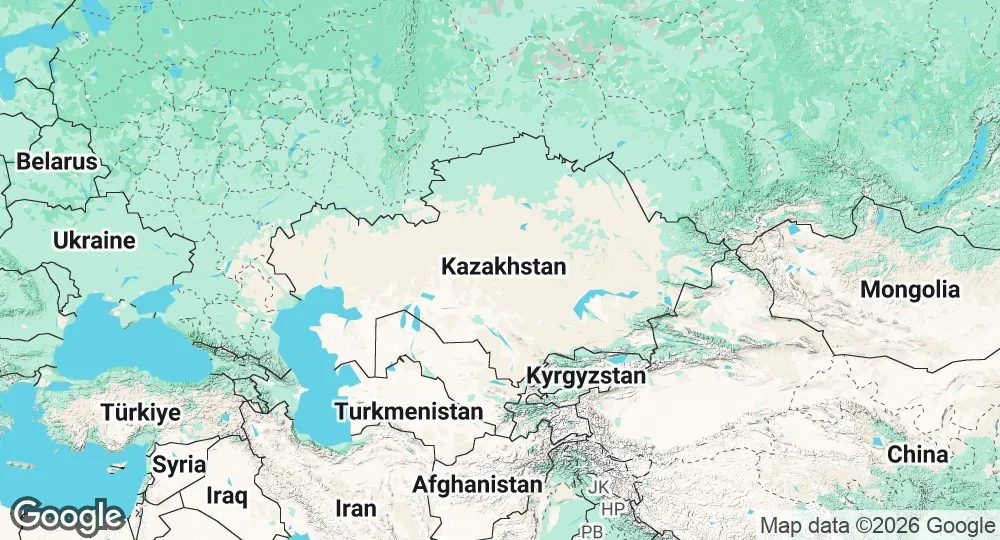
Kazakhstan’s defense posture is dictated by its landlocked geography in Central Asia, situated between the Russian Federation and the People’s Republic of China. The state employs a "multi-vector" foreign policy, seeking to balance security relationships with regional powers, Western nations, and international organizations.
Kazakhstan is a founding member of the Collective Security Treaty Organization (CSTO) and the Shanghai Cooperation Organization (SCO). While the CSTO provides a framework for collective defense and includes a Russian-led security guarantee, Kazakhstan also maintains a long-standing Partnership for Peace (PfP) agreement with NATO and conducts bilateral defense cooperation with Turkey, the United States, and China.
The primary security concerns for the Ministry of Defense include the maintenance of territorial integrity, border security—particularly regarding potential spillover from instability in Afghanistan—and the suppression of transnational threats such as terrorism, drug trafficking, and organized crime. National defense doctrine emphasizes a defensive character, focusing on localized conflict resolution and participation in international peacekeeping missions.
Military Forces
The Armed Forces of the Republic of Kazakhstan are organized into four main branches: Ground Forces, Air Defense Forces (which include the Air Force), Naval Forces, and the Special Operations Forces Command. These are supported by paramilitary formations, including the National Guard—subordinate to the Ministry of Internal Affairs—and the Border Service of the National Security Committee (KNB). Total active personnel across all branches is approximately 70,000 to 100,000, including paramilitary elements.
The Ground Forces are organized into four regional commands: Astana (East), South, West, and East. The inventory consists primarily of Soviet and Russian-origin equipment, supplemented by domestic and Western platforms. The army operates T-72 main battle tanks, BMP-2 infantry fighting vehicles, and BTR-80 and BTR-82A armored personnel carriers. Specialized mobility is provided by Arlan (Marauder) Mine-Resistant Ambush Protected (MRAP) vehicles produced domestically. Artillery capabilities include Grad and Uragan multiple launch rocket systems, as well as TOS-1A thermobaric launchers.
The Air Defense Forces integrate aviation and surface-to-air missile units. The combat fleet includes Su-30SM multirole fighters, Su-27 air superiority fighters, and MiG-31 interceptors. Transport requirements are met by C-295 and Shaanxi Y-8 aircraft. The military has increasingly integrated unmanned aerial vehicles (UAVs), including the Chinese Wing Loong series and the Turkish Anka. Air defense is provided by S-300 and Buk-M2E systems.
The Naval Forces operate exclusively in the Caspian Sea. The fleet consists of Kazakhstan-class missile boats, domestically built at the Zenit Shipyard, alongside smaller patrol craft and minesweepers. The mission profile focuses on the protection of offshore oil and gas infrastructure and coastal patrolling.
The Special Operations Forces Command, established to address asymmetric threats, focuses on counter-terrorism and reconnaissance. These units receive training and equipment from various international partners, including Turkey and the United States.
Defense Industry
The domestic defense industry is coordinated through the state-controlled holding company Kazakhstan Engineering. Production focuses on armored vehicles, naval vessels, and electronic systems through joint ventures with international partners.
Kazakhstan Paramount Engineering (KPE) produces the Arlan and Barys armored vehicles under license from South African designs. Kazakhstan Aselsan Engineering (KAE), a joint venture with Turkey, manufactures thermal imaging, night vision, and communication systems. The Zenit Shipyard in Uralsk produces patrol boats and fast attack craft for the Naval Forces and Border Service. Aircraft maintenance and modernization are conducted at the Aircraft Repair Plant No. 405 in Almaty, which services the regional fleet of Mi-8 and Mi-17 helicopters.
While Kazakhstan maintains a level of self-sufficiency in small arms, ammunition, and wheeled armored vehicles, it remains reliant on Russia for heavy armor, advanced aviation, and long-range air defense systems. Recent procurement trends indicate a shift toward diversifying imports, with 2025 and 2026 seeing increased acquisition of Turkish and European technologies.
Strategic Trends
The Ministry of Defense is currently focused on a comprehensive modernization program intended to transition from Soviet-era mass mobilization structures to a more mobile and technologically advanced force. A key priority in 2025 and 2026 is the expansion of the domestic UAV fleet and the integration of electronic warfare (EW) capabilities into all battalion-level formations.
The defense budget has seen a steady increase, with the government targeting approximately 1% of GDP for military expenditures in the 2025–2026 fiscal cycle. This funding is directed toward enhancing the Special Operations Forces and improving the readiness of territorial defense units.
A notable doctrinal shift is the emphasis on "network-centric" warfare and the digitization of command and control (C2) systems. Challenges remain, including the need to maintain interoperability between Russian-legacy platforms and newly acquired NATO-standard equipment. Additionally, the military faces constraints related to the professionalization of the NCO corps and the ongoing transition away from a conscription-heavy model toward a professional contract-based force.
Military Expenditure: CIA World Factbook. Last updated on 25 September 2026. Suggest a change
Frequently Asked Questions
How large is Kazakhstan's military?
What is Kazakhstan's defense budget?
How does Kazakhstan rank militarily in the world?
Does Kazakhstan have nuclear weapons?
How many aircraft does Kazakhstan's air force have?
How large is Kazakhstan's navy?
How many tanks does Kazakhstan have?
What percentage of GDP does Kazakhstan spend on defense?
What is Kazakhstan's military personnel per capita?
Does Kazakhstan have paramilitary forces?
- SEP 252026 Updated Population, GDP and inflation added for 2025
- AUG 112026 Updated Global Military Index updated
- AUG 42026 Updated Global Military Index updated in a site-wide editorial pass
- AUG 32026 Updated Global Military Index updated
- JUL 222026 Updated Rank insignia and ranks overview added
- JUL 162026 Updated Global Military Index updated in a site-wide editorial pass
- JUN 162026 Updated Yearly statistics, military spending and 2 more fields updated