Flag of Laos
Overview
| Country | Laos |
| Adopted | 1975 |
| Aspect ratio | 2:3 |
| Colors | |
| Elements | Horizontal stripes, circle |
Description
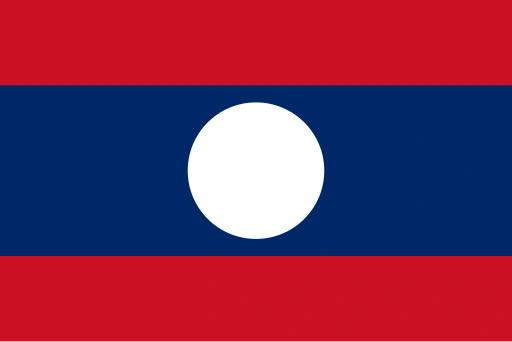
Three horizontal stripes compose the flag, with a central blue band that is double the height of the top and bottom red bands. A solid white circle is centered within the blue stripe. The layout adheres to a standard 2:3 width-to-length aspect ratio.
Symbolism
Red stripes signify the blood shed by the people in their struggle for independence against colonial forces. The blue band represents the Mekong River, which is central to the country's geography and economy, as well as the nation's wealth. Positioned in the center, the white circle symbolizes a full moon over the Mekong and represents the unity of the Lao people under a single government.
History
On December 2, 1975, the current flag was formally adopted to coincide with the proclamation of the Lao People's Democratic Republic. It replaced the previous royal standard, which featured a three-headed white elephant on a red field. The design was first conceived in 1945 by the Lao Issara nationalist movement during their brief period of governance. This transition signified the end of the monarchy and the establishment of a socialist state.