Laos Military Forces
Laos ranks #101 of 170 militaries worldwide in 2026, with 29,100 active troops. The Laotian Army fields 160 main battle tanks; the Air Force flies 32 aircraft, including 4 combat aircraft. Landlocked, Laos has no navy and no nuclear weapons.

Armed Forces in 2026
| Domain | Strength | Composition |
|---|---|---|
| Lao People's Liberation Army Air Force | 32 aircraft | 4 combat 23 helicopters +6 on order |
| Ground Forces | 160 tanks | |
| Personnel | 29,100 active | 100,000 paramilitary |
ATLAS Index (Aggregate Total of Land, Air and Sea strength)
Full ranking →| Pillar | Weight | Score | Basis |
|---|---|---|---|
| Manpower | 10% | 35.0 | Active, reserve & paramilitary personnel |
| Ground forces | 20% | 32.0 | ARMS inventory power: armour & artillery by type and era, attack helicopters, armament |
| Naval power | 20% | 0.0 | SEAS inventory power: hulls by type, size and era, air wing, sustainment, armament |
| Air power | 25% | 14.2 | AIRS inventory power: aircraft by type and generation, enablers, armament |
| Nuclear deterrent | 10% | 0.0 | No declared nuclear capability |
| Defense budget | 15% | 7.0 | Annual spending, purchasing-power adjusted |
| Availability | modifier | ground ×0.80 · naval ×1.00 · air ×0.80 | Budget per point of each force, from the branch indexes |
Country File
| Population | 7.9M (2025) |
| GDP | $18.3 billion (2025) |
| GDP per capita | $2,325 |
| Military budget | $23M (2013) |
| Share of GDP | 0.2% (2013) |
| Share of govt spending | 0.8% (2013) |
| Military spending per capita | $4 (2013) |
| Inflation rate | 7.74% (2025) |
| Capital | Vientiane |
| Region | Asia |
| Land area | 230,800 km² |
| Land borders | 5,083 km |
| Bordering countries | 5 |
| Currency | LAK |
Strategic Overview in 2026
Strategic Position
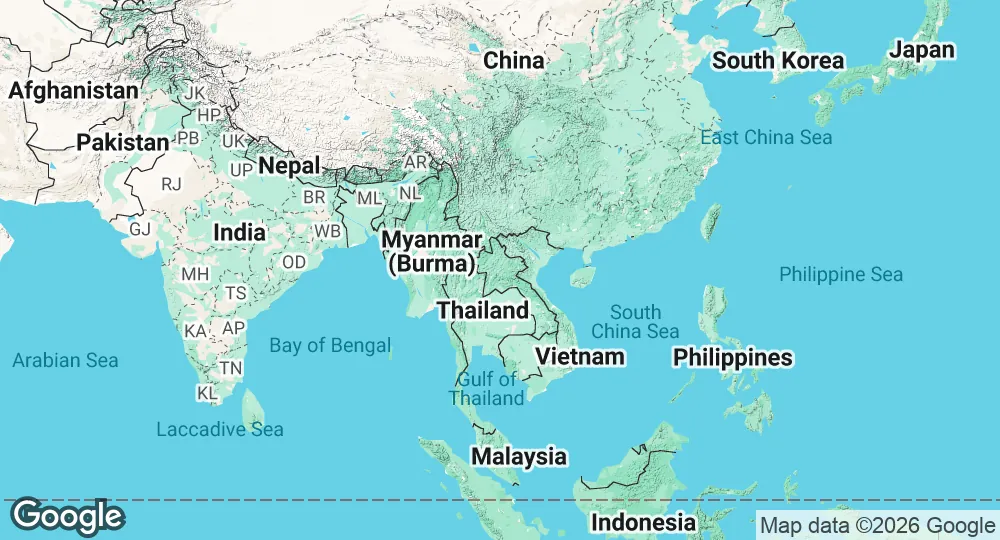
The Lao People’s Democratic Republic is a landlocked state in Southeast Asia bordering China, Vietnam, Thailand, Cambodia, and Myanmar. Its defense posture is primarily defined by its geography and the necessity of maintaining border security and internal stability. The state maintains a policy of non-interference and neutrality while relying on deep-seated bilateral security arrangements with neighboring Vietnam and expanding partnerships with Russia and China.
A central component of Lao defense policy is the 1977 Treaty of Amity and Cooperation with Vietnam, which remains a cornerstone of its security architecture. This relationship involves regular high-level exchanges and integrated defense cooperation plans, including a protocol for the 2025–2029 period. In late 2025, Vientiane and Hanoi reaffirmed these ties by finalizing a defense cooperation plan specifically for 2026, focusing on personnel training and joint border management.
In 2025, the military relationship with Russia reached a new stage with the establishment of a military cooperation roadmap extending through 2030. This partnership includes joint exercises, such as the Laros 2025 drill conducted in September 2025, which focused on counter-terrorism and operational coordination in mountainous terrain. While Laos maintains cordial relations with Thailand and China, it remains wary of external interference in its domestic political system, prioritizing regime survival and the territorial integrity of its remote border regions.
Military Forces
The Lao People’s Armed Forces (LPAF) operate under the direct command of the Lao People's Revolutionary Party (LPRP). The highest decision-making body is the Defence and Public Security Commission, chaired by the General Secretary of the LPRP. The LPAF is divided into the Lao People’s Army—which includes a riverine section—the Lao People’s Liberation Army Air Force, and the Self-Defense Militia Forces.
Personnel numbers consist of approximately 30,000 active-duty troops. This force is augmented by an extensive paramilitary and militia structure estimated at roughly 100,000 personnel, who are tasked with local defense and supporting internal security.
The Lao People’s Army is primarily an infantry-centric force. Its armored capabilities include T-72B1MS main battle tanks, alongside older T-54/55 and Type 59 variants. Armored reconnaissance and transport are provided by BRDM-2M and BTR-60 vehicles. The riverine force operates a small fleet of patrol craft on the Mekong River to monitor smuggling and secure the riverine border with Thailand and Myanmar.
The Lao People’s Liberation Army Air Force maintains a limited inventory focused on transport and light strike capabilities. Following the retirement of older Soviet-era fighters, the air branch utilizes Yak-130 advanced jet trainers as its primary combat platform. The helicopter fleet consists of Mi-17V-5 and Harbin Z-9 models, used for utility, transport, and search-and-rescue operations.
Strategic Trends
The primary modernization priority for the LPAF is the gradual replacement of Soviet-era equipment with more capable Russian and Chinese hardware, often through barter arrangements or long-term credit. In 2025, procurement activities remained focused on maintaining the recently acquired T-72 tanks and Yak-130 aircraft, while expanding training for specialized units, including sappers and special forces.
At the 12th National Congress of the LPRP in January 2026, the Ministry of National Defence emphasized a transition toward a "comprehensive all-people national defence posture." This doctrine prioritizes the integration of military tasks with socio-economic development, particularly in strategic rural areas and border village clusters. The goal is to create a multi-layered defense system where local militia forces serve as a primary layer of security against internal dissent and cross-border crime.
Defense spending remains a constraint on modernization, with the military budget estimated at approximately 0.2% to 0.5% of GDP. This low expenditure level necessitates a high degree of reliance on foreign assistance for infrastructure and training. Future development is likely to be characterized by continued dependence on Vietnamese military advisors and Russian technical support, as the state seeks to maintain a functional deterrent without the fiscal capacity for large-scale procurement programs.
Military Expenditure: information from the Stockholm International Peace Research Institute (SIPRI) Military Expenditure Database. Last updated on 25 September 2026. Suggest a change
Frequently Asked Questions
How large is Laos's military?
What is Laos's defense budget?
How does Laos rank militarily in the world?
Does Laos have nuclear weapons?
How many aircraft does Laos's air force have?
How many tanks does Laos have?
What percentage of GDP does Laos spend on defense?
What is Laos's military personnel per capita?
Does Laos have paramilitary forces?
- SEP 252026 Updated Population, GDP and inflation added for 2025
- AUG 42026 Updated Global Military Index updated in a site-wide editorial pass
- JUL 162026 Updated Global Military Index updated in a site-wide editorial pass
- JUN 162026 Updated Economic and demographic series refreshed (2 yearly records)
- JAN 172026 Updated Main battle tank count and Global Military Index updated
- JAN 132026 Updated Description updated
- JUN 212025 Updated Country data reviewed and updated