Flag of Libya
Overview
| Country | Libya |
| Adopted | 2011 |
| Aspect ratio | 1:2 |
| Colors | |
| Elements | Stars, crescent, horizontal stripes |
Description
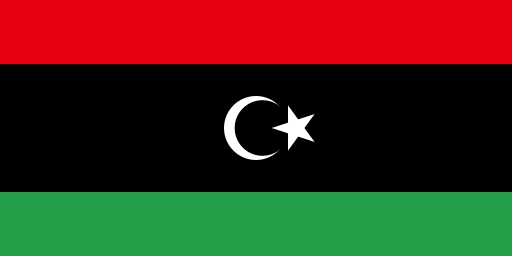
The national flag of Libya features three horizontal stripes of red, black, and green, with the central black stripe being double the width of the outer bands. A white crescent and a five-pointed star are positioned in the center of the black field.
Symbolism
Red symbolizes the blood of those who died during the Italian occupation, while green represents the religion of Islam and the lushness of the countryside. The central black band pays homage to the Senussi dynasty and the historical flag of Cyrenaica. Islamic identity is further emphasized by the white crescent and star, which symbolize the start of the lunar month and the light of faith. Collectively, these elements represent the three historical regions of Tripolitania, Cyrenaica, and Fezzan.
History
Initially adopted in 1951 upon Libya's independence under King Idris I, the design was later abandoned in 1969 following the military coup led by Muammar Gaddafi. The country utilized a red-white-black tricolor and then a solid green flag before the original 1951 design was reinstated by the National Transitional Council in 2011. This restoration occurred during the Libyan Civil War and was formalized as the national standard following the collapse of the previous administration. These changes reflected the shifting political ideologies of the nation over sixty years.