Libya Military Forces
Open-source order of battle for 2026: 32,000 active troops, 80 aircraft, 4 warships.
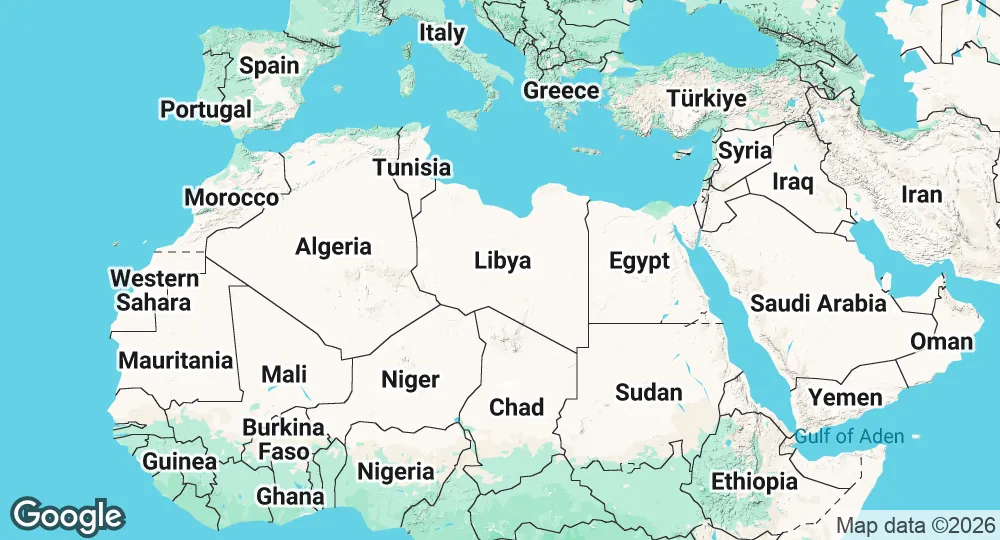
Armed Forces in 2026
| Domain | Strength | Composition |
|---|---|---|
| Air Force | 80 aircraft | 20 combat 17 helicopters 6 air bases +16 on order |
| Libyan Navy | 4 warships | 1 major combatants |
| Ground Forces | 43 tanks | |
| Personnel | 32,000 active |
ARMS Index (Aggregate Rating of Military Strength)
Full ranking →| Pillar | Weight | Score | Basis |
|---|---|---|---|
| Manpower | 15% | 55.8 | Active, reserve & paramilitary personnel |
| Ground forces | 20% | 38.4 | Tanks, armor & artillery weighted by type |
| Naval power | 20% | 17.8 | Weighted by hull type: carrier tiers, nuclear vs conventional submarines |
| Air power | 25% | 29.9 | Weighted by aircraft type and fleet age |
| Nuclear deterrent | 10% | 0.0 | No declared nuclear capability |
| Defense budget | 10% | 36.9 | Annual spending, purchasing-power adjusted |
| Readiness | modifier | ×1.02 | Budget per soldier: proxy for training, maintenance & technology |
Country File
| Population | 7.4M (2024) |
| GDP | $48.5 billion (2024) |
| GDP per capita | $6,569 |
| Military budget | $1.6B (2023) |
| Share of GDP | 5.3% (2023) |
| Share of govt spending | 5.5% (2023) |
| Military spending per capita | $217 (2023) |
| Inflation rate | 2.13% (2024) |
| Capital | Tripoli |
| Region | Africa |
| Land area | 1,759,540 km² |
| Coastline | 1,770 km |
| Land borders | 4,348 km |
| Bordering countries | 6 |
| Currency | LYD |
Strategic Overview in 2026
Strategic Position
Libya’s defense posture is characterized by a fragmented security architecture, divided between the internationally recognized Government of National Unity (GNU) in Tripoli and the Libyan National Army (LNA), also known as the Libyan Arab Armed Forces (LAAF), based in Benghazi. Geopolitical stability is currently maintained through a fragile ceasefire and a state of "managed fragmentation" where neither side can achieve decisive military superiority. Primary security concerns include the proliferation of non-state armed groups, illicit cross-border trafficking in the Sahel, and the influx of fighters and weapons from the civil war in neighboring Sudan.
Libya’s alliance structure is bifurcated by its domestic divisions. The GNU maintains a structural military partnership with Turkey, which was extended in late 2025 to continue through 2028. This partnership includes training, technical assistance, and the permanent stationing of Turkish personnel at bases such as Al-Watiya. Conversely, the LNA maintains deep military cooperation with Russia, which operates through the "Africa Corps" (formerly the Wagner Group). Russia utilizes eastern and southern Libyan airbases, such as Al-Jufra and Brak al-Shati, as logistical hubs for its operations in the Sahel. Additional regional support for the LNA historically includes Egypt and the United Arab Emirates, though the LNA began diversifying its military ties in 2025, engaging in preliminary arms and training discussions with Pakistan and Turkey.
Military Forces
The Libyan military is not a unified national entity. The GNU command structure incorporates a decentralized collection of semi-autonomous militias and specialized units, such as the 444th Brigade and the Deterrence Apparatus (RADA), which are formally integrated into the Ministry of Defense but often operate under localized leadership. The LNA operates as a more conventional hierarchical force under the command of Khalifa Haftar, utilizing a blend of regular military personnel, tribal militias, and foreign mercenaries. Personnel numbers are estimated between 20,000 for GNU-aligned units and 35,000 to 85,000 for the LNA.
Land Forces Both factions rely on aging Soviet-era inventories, including T-55, T-62, and T-72 main battle tanks. In response to modern battlefield threats, many of these platforms have been retrofitted with anti-drone cage armor. The LNA operates VPK Spartak mine-resistant ambush-protected (MRAP) vehicles and various Kamaz and Ural military trucks. The GNU utilizes Turkish-made BMC Vuran and Kirpi MRAPs. Both sides make extensive use of technicals—light trucks mounted with anti-aircraft guns or anti-tank guided missiles.
Air and Air Defense Forces The air domain is increasingly dominated by unmanned aerial vehicles (UAVs) and advanced air defense systems. The GNU operates Turkish Bayraktar TB2 and Akinci UAVs. The LNA inventory includes Chinese-origin Wing Loong and VT370 UAVs, as well as refurbished MiG-21, MiG-23, Su-24, and MiG-29 combat aircraft. In May 2025, the LNA publicly debuted Russian-made Tor-M2 short-range air defense systems, supplementing its existing fleet of Pantsir-S1 systems.
Joint and Specialized Units A notable development in force structure is the preparation for Exercise Flintlock 2026. Libya is designated to co-host this flagship special operations exercise, marks a rare instance of planned tactical cooperation between eastern and western units. The presence of the Russian "Africa Corps," estimated at 2,000 personnel, provides the LNA with advanced electronic warfare and logistical capabilities.
Strategic Trends
The primary strategic trend in Libya is the shift toward professionalization and modernization of hardware despite the ongoing UN arms embargo. Following a modification of the embargo in January 2025 to allow for technical assistance and training aimed at reunification, there has been an increase in international advisory presence, particularly from U.S. Africa Command (AFRICOM) and European partners.
Procurement priorities for both factions emphasize loitering munitions, counter-UAV systems, and electronic warfare suites. Defense spending remains difficult to track precisely due to fragmented financial institutions; however, a unified 2025 budget proposal estimated total state expenditures at approximately $31 billion, with a significant but opaque portion directed toward military salaries and equipment maintenance. The central challenge facing the military remains the political impasse that prevents the integration of rival command structures into a singular national defense force. Efforts by the 5+5 Joint Military Commission continue to focus on the eventual withdrawal of foreign forces and the unification of military institutions, though these goals remain unfulfilled as of 2026.
Military Expenditure: information from the Stockholm International Peace Research Institute (SIPRI) Military Expenditure Database. Last updated on 11 August 2026. Suggest a change
Frequently Asked Questions
How large is Libya's military?
What is Libya's defense budget?
How does Libya rank militarily in the world?
Does Libya have nuclear weapons?
How many aircraft does Libya's air force have?
How large is Libya's navy?
How many tanks does Libya have?
What percentage of GDP does Libya spend on defense?
What is Libya's military personnel per capita?
- AUG 112026 Updated Global Military Index updated
- AUG 42026 Updated Global Military Index updated in a site-wide editorial pass
- JUL 162026 Updated Global Military Index updated in a site-wide editorial pass
- JUN 162026 Updated Yearly statistics and Global Military Index updated
- JAN 172026 Updated Main battle tank count and Global Military Index updated
- JAN 132026 Updated Description updated
- JUN 132025 Updated Country data reviewed and updated