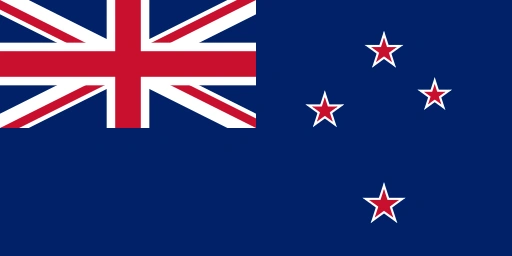
Flag of New Zealand
Overview
| Country | New Zealand |
| Adopted | 1902 |
| Aspect ratio | 1:2 |
| Colors | |
| Elements | Stars, cross |
Description
This ensign features a dark blue field with the Union Jack positioned in the canton. Four five-pointed red stars, each outlined in white, are arranged in a specific pattern on the fly side. The overall proportions of the flag follow a 1:2 aspect ratio.
Symbolism
Inclusion of the Union Jack in the upper hoist quadrant acknowledges New Zealand's historical ties to the United Kingdom and its Commonwealth heritage. The four red stars represent the Southern Cross constellation, signifying the nation's geographic location in the South Pacific Ocean. Blue symbolizes the surrounding sea and the clear sky, while the red and white colors reflect traditional heraldic palettes. These combined elements commemorate the country’s identity as a Pacific nation with constitutional links to the British monarchy.
History
New Zealand officially adopted this design as its national flag on March 24, 1902, following the passage of the New Zealand Ensign Act. Its origins trace back to 1867 when a similar version was introduced for colonial government vessels under the Colonial Naval Defence Act. Prior to this, the United Tribes flag served as the country’s first national ensign starting in 1834. Despite a two-stage national referendum in 2015 and 2016 regarding a potential change, the 1902 design was retained.