Flag of Papua New Guinea
Overview
| Country | Papua New Guinea |
| Adopted | 1971 |
| Aspect ratio | 3:4 |
| Colors | |
| Elements | Stars |
Description
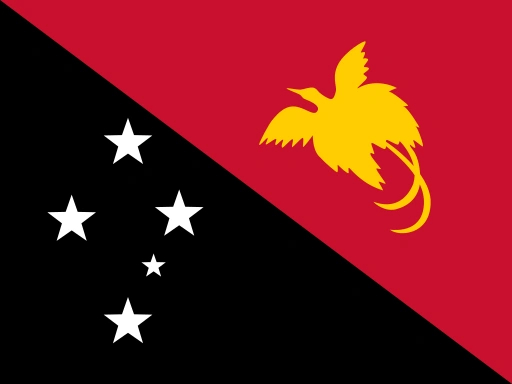
Divided diagonally from the upper hoist to the lower fly, the design consists of a red upper triangle and a black lower triangle. A yellow Raggiana bird of paradise in flight occupies the red field, while the black field features five white stars of varying sizes. These stars are arranged to form the Southern Cross constellation, with four five-pointed stars and one smaller four-pointed star.
Symbolism
Red and black represent the traditional colors of many indigenous tribes, reflecting the cultural heritage of the island's inhabitants. The Raggiana bird of paradise is a national emblem that signifies the emergence of the country as a unified nation and its unique biodiversity. By including the Southern Cross, the design denotes the country's geographical location in the Southern Hemisphere and commemorates its historical and navigational ties to other Pacific nations.
History
Adopted on July 1, 1971, the design was created by fifteen-year-old schoolgirl Susan Karike following a nationwide competition. This selection replaced a vertically striped green, yellow, and blue proposal that had met with little public enthusiasm. Prior to independence, the region was an Australian-administered territory and utilized colonial ensigns, but Karike's design was retained as the national flag when Papua New Guinea achieved full sovereignty in 1975.