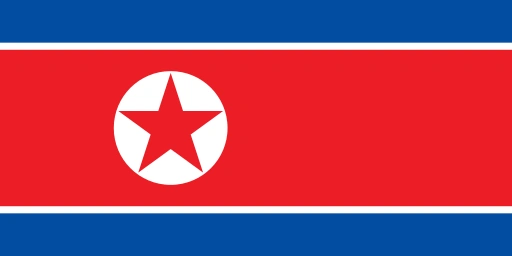
Flag of North Korea
Overview
| Country | North Korea |
| Adopted | 1948 |
| Aspect ratio | 1:2 |
| Colors | |
| Elements | Stars, horizontal stripes, circle |
Description
The flag features a broad central horizontal red stripe bordered above and below by thin white stripes and wider blue stripes. Offset toward the hoist side within the red band sits a white circle containing a five-pointed red star. The overall design maintains a 1:2 aspect ratio.
Symbolism
The central red stripe represents the revolutionary traditions and the blood shed by patriots during the anti-Japanese struggle. Blue bands signify the desire for sovereignty, peace, and international friendship, while the narrow white stripes denote the purity of the Korean nation. A five-pointed red star within the white disk symbolizes the building of socialism and the bright future of the country. Historically, the white circle also references the taegeuk, though it was repurposed to serve as a backdrop for the socialist star.
History
Adopted on September 8, 1948, this design replaced the Taegukgi following the establishment of the Democratic People's Republic of Korea. Soviet officials, including General Nikolai Lebedev, reportedly influenced the design process to align the state's imagery with socialist motifs. Although the proportions of the central disk and star were slightly modified in 1992, the fundamental layout has remained unchanged for over seven decades. This transition marked a definitive break from the traditional symbols used during the Joseon dynasty and the provisional government.