Naval Air Facility El Centro
Summary
| Operating Country | 🇺🇸 United States |
| Location | 🇺🇸 United States |
| Status | ◉ Active |
| Usage | Military only |
| Year built | 1942 |
| Operating Organization | US Navy |
| Units |
|
Location & Details
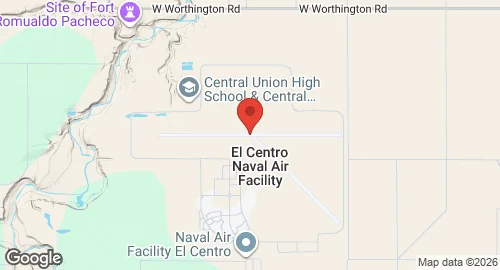
| Coordinates | 32.8292°N, -115.6717°E |
| Elevation | -42 m (-138 ft) |
| IATA code | NJK |
| ICAO code | KNJK |
| Runways |
|
| Website | www.cnic.navy.mil/Regions/cnrsw/installations/naf_el_centro/ |
Description
Naval Air Facility (NAF) El Centro is located six miles northwest of El Centro in Imperial County, California. The site was originally established as Camp Seeley by the United States Army in 1940. Following the expansion of local aviation infrastructure during World War II, the United States Navy leased the area, and Marine Corps Air Station (MCAS) El Centro was commissioned on July 23, 1943. During the war, the station functioned as a training and reorganization base for Marine Corps squadrons and hosted a Marine Corps Aerial Gunnery School. The facility was transferred to the Navy on May 1, 1946, and was designated a Naval Air Station. It received its current designation as a Naval Air Facility in 1979. For several decades, the installation’s mission focused on aeronautical escape system testing and parachute development, supported by the Parachute Experimental Division and the Joint Parachute Facility.
The facility is operated by the US Navy under the jurisdiction of Navy Region Southwest. Its current mission is to provide a training environment for military units conducting air-to-air and bombing exercises. NAF El Centro is the winter training home for the U.S. Navy Flight Demonstration Squadron, the Blue Angels. The base also hosts the British Joint Helicopter Force (US), a component of the Joint Helicopter Command.
Infrastructure includes two operational runways. To facilitate simulated carrier landings, the airfield is equipped with Fresnel lens optical landing systems (FLOLS) and illuminated carrier flight deck landing areas at the runway ends. The installation maintains remote-controlled target areas for ordnance delivery and desert ranges for air-to-ground bombing, rocket firing, strafing, and mobile land target training. Scoring and evaluation are conducted via the Weapons Impact Scoring System and the Display and Debriefing Subsystem (DDS). The DDS is integrated with the Tactical Air Crew Training System (TACTS) to provide computerized records and analysis of air combat maneuvers.