Abukuma-class
Summary
| Origin country | 🇯🇵 Japan |
| Category | Frigate |
| Subtype | Destroyer escort |
| Manufacturer | Mitsui Engineering and Shipbuilding Company Limited |
| Year commissioned | 1989 |
| Unit | JS Abukuma, JS Jintsū, JS Ōyodo, JS Sendai, JS Chikuma, JS Tone |
Operators
Technical specifications
| Displacement | 2550 tons |
| Crew | 120 members |
| Width | 13.0 m (42.7 ft) |
| Length | 109.0 m (357.6 ft) |
| Propulsion | CODOG, two shafts: 2 × Kawasaki-RR SM1A gas turbines 26,650 hp (19,870 kW) and 2 × Mitsubishi S12U MTK diesels 6,000 hp (4,500 kW) |
| Armament |
|
| Maximum speed | 27 knots |
Description
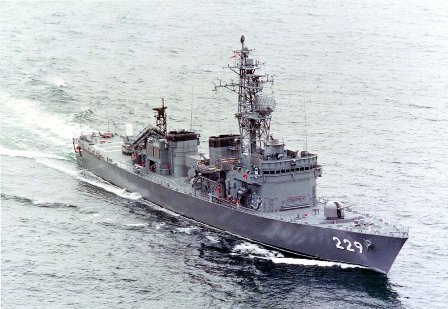
The Abukuma-class is a general-purpose destroyer escort class operated by the Japan Maritime Self-Defense Force (JMSDF). Developed as the successor to the Yūbari class, the design replaced the Isuzu and Chikugo classes by integrating anti-submarine and anti-surface warfare functions. Although eleven ships were planned, production concluded with six vessels built between 1988 and 1991. The remaining five units were canceled following the deployment of Hatsuyuki-class destroyers.
The class incorporates angled hulls to reduce radar cross-section, representing the first use of stealth technology in a JMSDF combatant. It also introduced the Naval Tactical Data System (NTDS), the OYQ-7 combat direction system, and electronic countermeasure functions through the OLT-3 jammer to the destroyer escort category. Sensor systems include air-search, surface search, and target acquisition radars, alongside a hull sonar.
Armament consists of Harpoon anti-ship missiles, ASROC anti-submarine rockets, and an Otobreda gun. Defensive systems include a Phalanx Close-In Weapon System (CIWS) and triple torpedo tubes. While the design included provisions for a Rolling Airframe Missile (RAM) system and a tactical towed-array sonar, these were not implemented.
Six vessels—Abukuma, Jintsū, Ōyodo, Sendai, Chikuma, and Tone—were commissioned between 1989 and 1993. These ships are assigned to Kure, Sasebo, Ominato, and Maizuru. The class is currently being replaced by Mogami-class frigates. In 2025, Japan and the Philippines entered discussions regarding the potential transfer of these vessels. The Philippine Navy is evaluating the acquisition of three to six ships, with status inspections scheduled for 2025.