Agosta-class
Summary
| Origin country | 🇫🇷 France |
| Category | Submarine |
| Subtype | Diesel-electric attack submarine |
| Manufacturer | DCNS |
| Year commissioned | 1977 |
| Approx. unit cost | $950 million |
| Units |
S135 PNS Hashmat S136 PNS Hurmat S137 PNS Khalid S138 PNS Saad S139 PNS Hamza |
Technical specifications
| Displacement | 1524 tons |
| Displacement submerged | 1788 tons |
| Range | 8500 km |
| Crew | 41 members |
| Width | 6.0 m (19.7 ft) |
| Length | 67.0 m (219.8 ft) |
| Max. depth | 300 m (984.3 ft) |
| Propulsion | diesel-electric |
| Armament |
|
| Maximum speed | 12 knots |
| Max. speed submerged | 20 knots |
Description
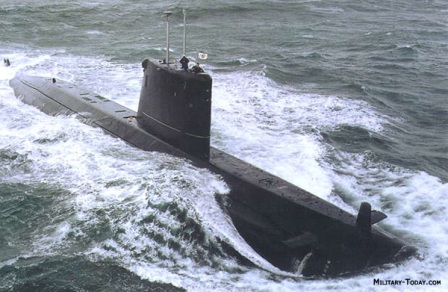
The Agosta class is a series of diesel-electric attack submarines developed by the French firm DCNS during the 1970s as a successor to the Daphné class. The French Navy categorized the design as "océanique" (ocean-going). The class name is derived from the 1676 Battle of Augusta. While initially produced for French service, the class was also manufactured for export. In 1974, South Africa entered negotiations to acquire two Agosta-70 submarines, but France halted the delivery following the implementation of United Nations Resolution 418. These two hulls were subsequently sold to Pakistan.
The submarine utilizes a single-hull design constructed from 80 HLES high-elasticity steel, with diving planes located high on the conning tower. The Agosta-90B variant is an improved version of the original design, featuring higher levels of automatic control and the option for MESMA air-independent propulsion (AIP). This variant was produced through a technology transfer agreement between France and Pakistan, allowing for domestic assembly and eventual commercial production licensing. The 90B variant is capable of deploying SM39 Exocet missiles and seaborne nuclear cruise missiles.
The French Navy commissioned four units between 1977 and 1978. These were withdrawn from service by 2001 and replaced by Rubis-class nuclear attack submarines. The decommissioned French vessel Ouessant was transferred to the Royal Malaysian Navy for use as a training platform. Spain operated four vessels, designated the Galerna class, built at the Cartagena dockyard. These units entered service between 1983 and 1985; the final active Spanish vessel, Tramontana, was decommissioned in 2024.
Pakistan remains the primary operator of the class, maintaining both the Agosta-70 (Hashmat class) and the Agosta-90B (Khalid class). The Hashmat class conducted deployments in the Arabian Sea and Indian Ocean during the 1980s. The Khalid-class units were commissioned between 1999 and 2006, with two of the three vessels assembled in Pakistan. In 2018, the Pakistan Navy began a mid-life upgrade program for the 90B fleet conducted by the Turkish company STM. This program replaces the sonar suite, periscope systems, radar, and command and control systems with modern hardware, including SharpEye low probability-of-intercept radar.