Asagiri-class
Summary
| Origin country | 🇯🇵 Japan |
| Category | Destroyer |
| Subtype | General-purpose destroyer |
| Manufacturer | Ishikawajima-Harima Heavy Industries |
| Year commissioned | 1988 |
| Unit | JS Asagiri, JS Yamagiri, JS Yūgiri, JS Amagiri, JS Hamagiri, JS Setogiri, JS Sawagiri, JS Umigiri |
Operators
Technical specifications
| Displacement | 4900 tons |
| Range | 6000 km at 20 knots |
| Crew | 220 members |
| Width | 14.6 m (47.9 ft) |
| Length | 137.0 m (449.5 ft) |
| Air Park |
|
| Propulsion | 4 × KHI-RR SM1A gas turbines, 54,000 shp (40,268 kW), 2 shafts, cp props |
| Armament |
|
| Maximum speed | 30 knots |
Description
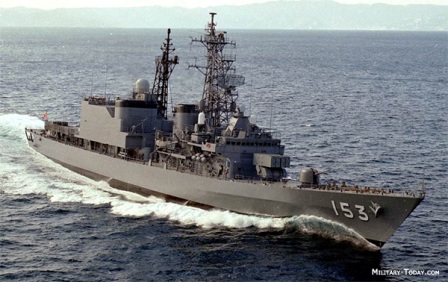
The Asagiri class is a series of general-purpose destroyers operated by the Japan Maritime Self-Defense Force (JMSDF). It is the second class of first-generation general-purpose destroyers developed under the "eight ships / eight helicopters" concept, which allocated five general-purpose destroyers to each flotilla. The class was designed as an evolution of the preceding Hatsuyuki class to improve C4I functions, resistance, and durability.
The hull uses a shelter deck style and is an enlarged version of the Hatsuyuki design. The upper structure is constructed of steel. Propulsion is configured in a COGAG arrangement with gas turbines in an alternating layout to enhance survivability. The combat direction system supports Link-11 tactical data exchange, and ships were later retrofitted with satellite communication terminals for the MOF C4I system. Sensor equipment varies between production batches; earlier ships carry an air-search radar, while later units utilize a 3D active electronically scanned array radar. Electronic warfare systems were updated in later batches with an emphasis on anti-ship missile defense. The aviation facilities include a hangar enlarged to accommodate two helicopters, though one is typically carried for operations.
Eight vessels were built between 1986 and 1989, and all remain active. Several units, including the Asagiri and Yamagiri, have transitioned between destroyer and training vessel roles during their service history. In 1996, the Yūgiri shot down a US Navy A-6E Intruder during a live-fire exercise at RIMPAC. Both aviators were rescued by the Yūgiri, and the incident was attributed to human error.