Astute-class
Summary
| Origin country | 🇬🇧 United Kingdom |
| Category | Submarine |
| Subtype | Nuclear-powered attack submarine |
| Manufacturer | BAE Systems Submarines |
| Year commissioned | 2010 |
| Approx. unit cost | $2112 million |
| Units |
S119 HMS Astute S120 HMS Ambush S121 HMS Artful S122 HMS Audacious S123 HMS Anson |
Operators
Technical specifications
| Displacement | 7400 tons |
| Displacement submerged | 7800 tons |
| Range | Unlimited, except by food supplies |
| Endurance | 90 |
| Crew | 98 members |
| Width | 11.3 m (37.1 ft) |
| Length | 97.0 m (318.2 ft) |
| Max. depth | 300 m (984.3 ft) |
| Propulsion | 1 × Rolls-Royce PWR2 nuclear reactor; MTU 600 kilowatt diesel generators |
| Armament |
|
| Maximum speed | 10 knots |
| Max. speed submerged | 30 knots |
Description
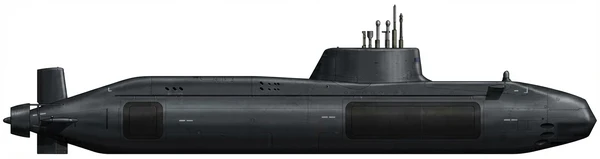
The Astute class is the current generation of nuclear-powered attack submarines in service with the Royal Navy. The programme originated in February 1986 as project SSN20, a study intended to replace the Swiftsure and Trafalgar classes. Following the end of the Cold War, SSN20 was cancelled in favor of a lower-cost derivative of the Trafalgar class, known as the Batch 2 Trafalgar class (B2TC). In 1997, the Ministry of Defence signed a fixed-price contract with GEC-Marconi for the first three vessels. The design eventually moved away from the B2TC concept to accommodate the Rolls-Royce PWR2 reactor, resulting in an entirely new class of submarine.
Construction is carried out by BAE Systems Submarines at the Barrow-in-Furness shipyard. The vessels were the first nuclear submarines designed using 3D computer software. Manufacturing utilizes modular construction and vertical outfitting techniques. The propulsion system consists of a Rolls-Royce PWR2 pressurized water reactor and a pump-jet propulsor. The reactor core is designed to last for the 25-year service life of the vessel without refuelling. To minimize the sonar signature, the hull is covered with more than 39,000 acoustic tiles.
Sensors and processing systems include the Sonar 2076, an integrated passive/active search and attack suite with bow, intercept, flank, and towed arrays. The boats utilize two non-hull-penetrating optronic masts rather than conventional periscopes, incorporating thermal imaging and low-light television sensors. The bridge fin is reinforced for surfacing through ice, and the vessels can be fitted with a dry deck shelter for special forces operations. Internal accommodation includes individual bunks for all crew members.
The Royal Navy plans a total of seven boats. The first of class, HMS Astute, was commissioned in 2010 and declared operational in 2014. In 2012, the class participated in Exercise Fellowship, conducting simulated engagements with the United States Navy Virginia-class submarine USS New Mexico.
Service history includes several reported incidents. In 2010, HMS Astute ran aground during trials off the Isle of Skye. In 2011, a fatal shooting occurred on board the lead vessel while it was docked in Southampton. HMS Ambush sustained conning tower damage in 2016 following a collision with a merchant ship during exercises near Gibraltar. Under the AUKUS partnership, one Astute-class submarine is scheduled to forward operate from HMAS Stirling in Western Australia starting as early as 2027. The class is expected to be replaced by the SSN-AUKUS design beginning in the late 2030s.