Charlie-class
Summary
| Origin country | 🇨🇳 Ex-USSR |
| Category | Submarine |
| Subtype | Nuclear-powered cruise missile submarine |
| Manufacturer | Krasnoye Sormovo inland shipyard |
| Year commissioned | 1967 |
| Units | K-25, K-43, K-87, K121, K-201, K-302, K-308, K-313, K-320, K-325, K-429 (CHARLIE I), K-219, K-452, K-458, K-479, K-503, K-508 (CHARLIE II) |
Operators
Technical specifications
| Displacement | 4000 tons |
| Displacement submerged | 4900 tons |
| Range | Unlimited, except by food supplies |
| Crew | 100 members |
| Width | 10.0 m (32.8 ft) |
| Length | 95.0 m (311.7 ft) |
| Max. depth | 400 m (1312.3 ft) |
| Propulsion | 1 pressurized water-cooled reactor powering 2 steam turbines delivering 11,185 kW (14,999 shp) to 1 shaft |
| Armament |
|
| Maximum speed | 20 knots |
| Max. speed submerged | 24 knots |
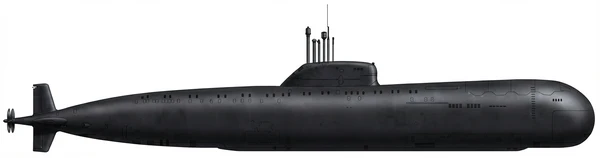
Description
The Project 670 Skat, designated by NATO as the Charlie class, is a nuclear-powered cruise missile submarine design developed by the Lazurit Central Design Bureau in Gorky. The class consists of two variants: the Charlie I (Project 670) and the Charlie II (Project 670M). Construction of the vessels took place at the Krasnoye Sormovo inland shipyard. The first Charlie I hull was launched in 1967, and the improved Charlie II variant entered production in the 1970s.
The Charlie I design features missile tubes mounted in the bow, external to the pressure hull and angled upward. These tubes were intended to carry anti-ship missiles for pop-up surprise attacks against surface targets, specifically aircraft carriers. While originally designed for the P-120 Malakhit missile, development delays led to the integration of the P-70 Ametist submerged-launch missile in the Charlie I variant. The Charlie II incorporates a hull insert forward of the fin to accommodate the electronics and launch systems required for the longer-range P-120 Malakhit. For secondary roles, both variants are equipped with bow-mounted torpedo tubes for anti-ship and anti-submarine warfare and are capable of carrying ground mines. Propulsion is provided by a single-shaft arrangement powered by a pressurized water-cooled reactor and steam turbines.
The Soviet Navy operated the majority of the class, with boats later serving in the Russian Navy. In 1988, the Soviet Union leased the K-43 to the Indian Navy, where it was commissioned as INS Chakra. This vessel was utilized for crew training and provided design data for the Indian Arihant-class submarine program. Operational records indicate that K-429 sank twice: once in 1983 near Petropavlovsk-Kamchatsky and again at its moorings in 1985 after being raised. One unit was used as a testbed for the Oniks missile. The Charlie class was gradually withdrawn from service beginning in the late 1980s, and all boats were decommissioned and scrapped by the mid-1990s.