Arihant-class
Indian nuclear-powered submarine, introduced in 2016, displaces 6,000 tons and has a crew of 95. Key figures: displacement 6,000 tons, length 111 m, top speed 15 knots, crew 95, unit cost $470M, built 4. In service with 1 navy — India (3).
| Subtype | Nuclear-powered ballistic missile submarine |
| Displacement | 6000 tons |
| Displacement submerged | 7000 tons |
| Crew | 95 members |
| Width | 11.0 m (36.1 ft) |
| Length | 111.0 m (364.2 ft) |
| Max. depth | 450 m (1476.4 ft) |
| Propulsion | 1 x CLWR-B1 pressurized water reactor (83 MW-100MW), 1 x shaft |
| Range | Unlimited, except by food supplies |
| Maximum speed | 15 knots |
| Max. speed submerged | 24 knots |
- 12 x K15 SLBM
- 4 x K-4 SLBM
- 24 x K15 SLBM
- 8 x K-4 SLBM
- 8 x K-5 SLBM
- 6 x 21" (533 mm) torpedo tubes
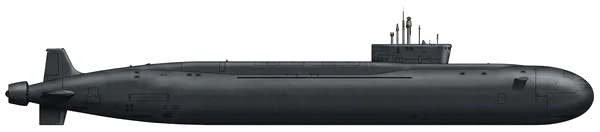
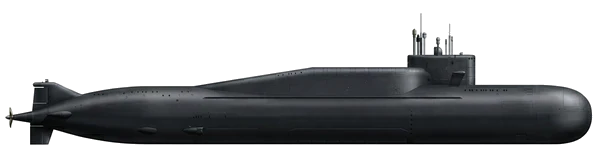
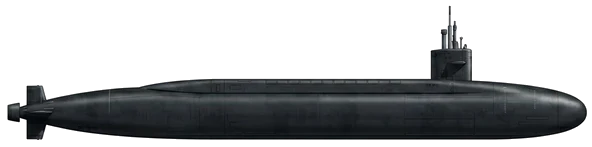
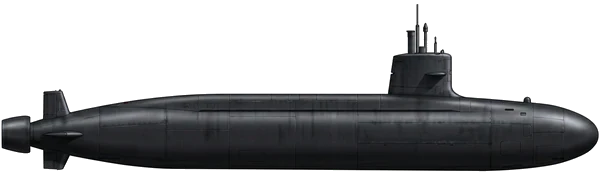
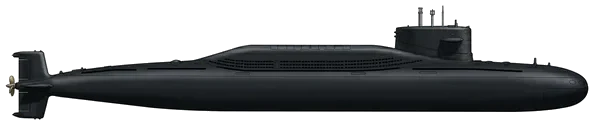
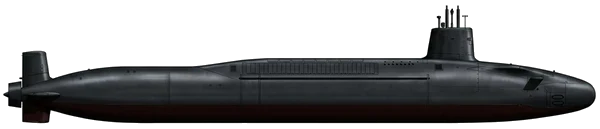
Description
The Arihant class is a series of nuclear-powered ballistic missile submarines built for the Indian Navy of India. The submarines were developed under the Advanced Technology Vessel project, which was initiated as Project 932 following the 1974 Smiling Buddha nuclear test. This project was prompted by the deployment of the US carrier battle group Task Force 74 into the Bay of Bengal during the 1971 Indo-Pakistani War. Originally planned as nuclear-powered fast attack submarines, the program was re-aligned to design ballistic missile submarines following India's 1998 nuclear tests to complete the nuclear triad. Larsen & Toubro undertook hull construction and detailed engineering, Tata Power SED built the control systems, and Walchandnagar Industries supplied the steam turbines. The boats are constructed at the Ship Building Centre in Visakhapatnam. A prototype pressurized light-water reactor, S1, was built by the Bhabha Atomic Research Centre at Kalpakkam to validate the propulsion design and train nuclear submariners.
The Arihant-class submarines utilize a double hull constructed from Russian steel equivalent to US HY-80 grade. The vessels contain two main compartments housing the propulsion, combat management, platform management, and torpedo systems. Propulsion is provided by a pressurized light-water reactor fueled by highly enriched uranium, driving a single seven-blade propeller. Sensor systems include USHUS and Panchendriya sonars. For armament, the submarines feature six 533 mm torpedo tubes. The first two boats, INS Arihant and INS Arighaat, carry four vertical launch tubes capable of housing either twelve K-15 Sagarika or four K-4 ballistic missiles. The subsequent vessels, INS Aridhaman and Arisudan, feature the "Arihant Stretch" design, which incorporates four additional launch tubes, allowing a total capacity of twenty-four K-15 Sagarika or eight K-4 missiles.
To prepare for operations, Indian Navy personnel underwent training on the ex-Russian Akula-class submarine INS Chakra, leased in 2012. INS Arihant was launched on 26 July 2009, achieved reactor criticality in August 2013, and entered service in August 2016. The submarine completed its first 20-day deterrence patrol in November 2018. INS Arighaat was launched in November 2017 and entered service on 29 August 2024. By October 2024, both Arihant and Arighaat were deployed on deep-sea patrols. The third vessel of the class, INS Aridhaman, was launched in November 2021, completed sea trials in December 2025, and entered service on 3 April 2026. The fourth submarine, Arisudan, was launched on 16 October 2024 and commenced sea trials in December 2025.
Frequently Asked Questions
What type of ship is the Arihant-class?
What is the displacement of the Arihant-class?
What is the maximum speed of the Arihant-class?
What is the range of the Arihant-class?
How many crew members serve on the Arihant-class?
How many Arihant-class ships have been built?
Which countries operate the Arihant-class?
How much does a Arihant-class cost?
- JUL 292026 Updated Description updated
- JAN 242026 Updated Range added
- JAN 182026 Created Page created: Arihant