Cyclone-class (PC-1)
Summary
| Origin country | 🇺🇸 United States |
| Category | Patrol vessel |
| Subtype | Coastal patrol ship |
| Manufacturer | Bollinger Shipyards |
| Year commissioned | 1993 |
| Units | USS Cyclone, USS Tempest, USS Hurricane, USS Monsoon, USS Typhoon, USS Sirocco, USS Squall, USS Zephyr, USS Chinook, USS Firebolt, USS Whirlwind, USS Thunderbolt, USS Shamal, USS Tornado |
Operators
Technical specifications
| Displacement | 336 tons |
| Range | 2500 km at 12 knots |
| Crew | 28 members |
| Width | 7.6 m (24.9 ft) |
| Length | 55.0 m (180.4 ft) |
| Propulsion | 4 × Paxman 16RP200- 1-CM 3,350 shp (2,500 kW) diesel engines (13,400 shp (10,000 kW) combined), 4 × shafts, Reintjes reverse reduction gear box |
| Thrust | 310 hp |
| Armament |
|
| Maximum speed | 35 knots |
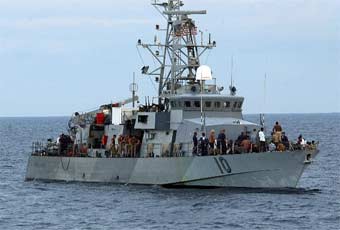
Description
The Cyclone class is a series of coastal patrol ships developed to replace the Vietnam-era PB Mk III patrol boats. Following the cancellation of the Special Warfare Craft, Medium prototype in 1987, the United States Navy selected a design from Bollinger Shipyards based on the Vosper Thornycroft Province-class fast attack craft. Although 16 vessels were originally planned, the program concluded after 14 ships were completed because the design was determined to be too large for the SEAL delivery role. The ships were designated as Patrol Coastal (PC) and entered service between 1993 and 2000.
The primary mission of the class is coastal patrol, interdiction surveillance, and littoral operations. These vessels provide a platform for special operations forces, including U.S. Navy SEALs, in low-intensity conflict environments. The ships are powered by four diesel engines driving four shafts. While designed for a 15-year service life, the majority of the class remained in operation beyond this timeframe. In 2010, the ships were recalled for repairs following the identification of fatigue damage to the hulls. The vessels are equipped with autocannons, machine guns, automatic grenade launchers, and surface-to-air missiles.
Initially assigned to the United States Naval Special Warfare Command, the vessels operated from Naval Amphibious Base Little Creek and Naval Amphibious Base Coronado. Between 2000 and 2011, several ships were loaned to the U.S. Coast Guard for search and rescue, maritime interception, and port security duties. Following the 2003 occupation of Iraq, the class deployed to the Persian Gulf to protect offshore oil terminals. By 2015, ten vessels were stationed at Naval Support Activity Bahrain to conduct maritime security operations. The remaining units were stationed at Naval Station Mayport, Florida, for drug interdiction duties with the U.S. Fourth Fleet.
The United States Navy decommissioned the final ships of the class in March 2023. Several vessels have been transferred to international partners. The Royal Bahraini Naval Force commissioned five units in 2022. The Philippine Navy operates three vessels, including the lead ship transferred in 2004 and two units transferred in 2023. The Egyptian Navy received three ships in 2023. Of the remaining retired vessels, two were designated for scrapping and one was made available for foreign military sale.