Echo-class
Summary
| Origin country | 🇨🇳 Ex-USSR |
| Category | Submarine |
| Subtype | Nuclear-powered cruise-missile submarine |
| Manufacturer | Komsomolsk-on-Amur, shipyard No. 199 |
| Year commissioned | 1960 |
| Units | K-45, K-59, K-66, K-122, K-151, K-166, K-104, K-170, K-175, K-184, K-172, K-47, K-1, K-28, K-35, K-189, K-74, K-22, K-90, K-31, K-116, K-57, K-125, K-48, K-128, K-56, K-131, K-10, K-135, K-94, K-108, K-7, K-23, K-34 |
Operators
Technical specifications
| Displacement | 4486 tons |
| Displacement submerged | 5852 tons |
| Range | 30000 km |
| Endurance | 50 |
| Crew | 109 members |
| Width | 9.3 m (30.5 ft) |
| Length | 115.4 m (378.6 ft) |
| Max. depth | 300 m (984.3 ft) |
| Propulsion | 2 pressurized water-cooled reactors 70,000 hp (52 MW) each, 2 steam turbines, 2 shafts |
| Armament |
|
| Maximum speed | 15 knots |
| Max. speed submerged | 24 knots |
Description
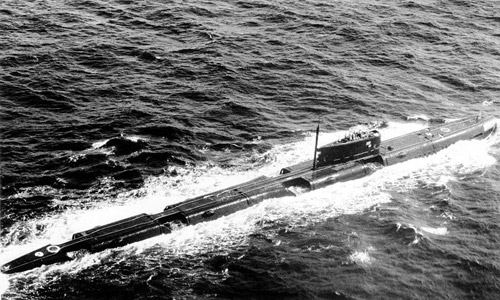
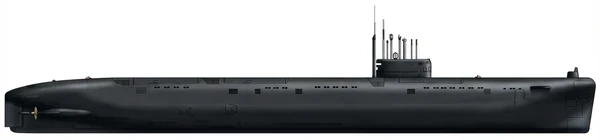
The Echo class comprised Soviet nuclear-powered cruise missile submarines constructed during the 1960s. Designated Project 659 (Echo I) and Project 675 (Echo II), the vessels were produced at Shipyard No. 199 in Komsomolsk-on-Amur and Shipyard No. 402 in Severodvinsk. The class followed the Whiskey Long Bin class and preceded the Juliett and Charlie classes.
Project 659 vessels initially operated in a strategic land-attack role. Due to a lack of fire control and guidance radars for anti-shipping operations, these submarines were converted to Project 659T attack submarines between 1969 and 1974. The conversion included the removal of missile launchers, the plating and streamlining of the hull to reduce underwater noise, and the modification of sonar systems to the standard of November-class submarines. Project 675 was designed for anti-carrier operations. These submarines featured fire control and guidance radars and carried anti-ship missiles mounted in pairs above the pressure hull. Launching required the submarine to surface and elevate the launchers. The vessel remained on the surface to provide mid-course corrections and target selection unless guidance was transferred to an external party. Upgrades included Project 675M, distinguished by bulges on either side of the sail, and Project 675MKV, which incorporated titanium components to reduce weight and an improved propulsion system.
The class entered service in 1960. Echo I units were assigned to the Pacific Fleet, while Echo II units were distributed between the Northern and Pacific Fleets. Service history included several maritime accidents. Collisions occurred with vessels including USS Tautog, USS Voge, and the fishing trawler Novokachalinsk. Internal fires were recorded on K-47, K-122, and K-131. Reactor-related incidents occurred on several hulls, including core coolant leaks, a reactor explosion during refueling at Chazhma Bay, and an explosion in the reactor compartment of K-175. The Echo I fleet was decommissioned or converted by the early 1990s. Echo II vessels were removed from service between 1989 and 1995, with all units decommissioned by July 1994.