Enterprise-class (CVN-65)
Summary
| Origin country | 🇺🇸 United States |
| Category | Aircraft carrier |
| Subtype | Nuclear-powered aircraft carrier |
| Manufacturer | Newport News Shipbuilding |
| Year commissioned | 1961 |
| Approx. unit cost | $451 million |
| Units | USS Enterprise (CVN-65) |
Operators
Technical specifications
| Displacement | 94781 tons |
| Range | Unlimited, except by food supplies |
| Crew | 5828 members |
| Width | 78.4 m (257.2 ft) |
| Length | 342.0 m (1122.0 ft) |
| Air Park |
|
| Propulsion | 8 × Westinghouse A2W nuclear reactors, 4 x Westinghouse geared steam turbines, 4 × shafts, 280,000 shp (210 MW) |
| Thrust | 40000 hp |
| Armament |
|
| Maximum speed | 33 knots |
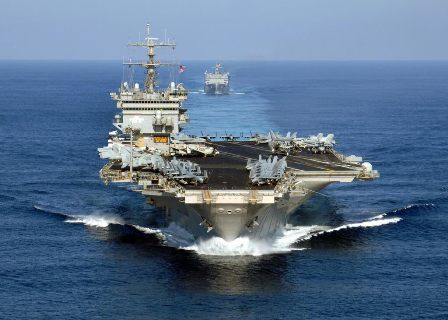
Description
Ordered in 1957 under project SCB 160, this vessel was constructed by Newport News Shipbuilding as the first nuclear-powered aircraft carrier. It was intended as the lead ship of a six-vessel class, but the remaining five ships were cancelled due to construction costs. The ship was commissioned in November 1961.
The propulsion system consists of eight nuclear reactors driving four shafts. The hull design is derived from cruiser patterns and incorporates four rudders. For aircraft operations, the vessel utilizes four steam-powered catapults and can accommodate various air wing configurations. The original design featured the SCANFAR phased-array radar system, which determined the square shape of the island superstructure. This system was removed during a 1979–1982 refit and replaced with conventional radar suites. Defensive armament evolved from early missile systems to include Sea Sparrow launchers, Phalanx Close-In Weapon Systems, and Rolling Airframe Missiles.
Service history began with shakedown cruises and a role as a tracking station for the Project Mercury orbital flight in 1962. Later that year, the vessel participated in the naval blockade of Cuba. In 1964, it formed Task Force One with the vessels Long Beach and Bainbridge for Operation Sea Orbit, the first circumnavigation of the globe by nuclear-powered ships.
From 1965, the carrier conducted multiple deployments in the Vietnam War, marking the first combat use of a nuclear-powered ship. In January 1969, a rocket explosion on the flight deck initiated a fire that resulted in 27 fatalities and 314 injuries, requiring repairs to the flight deck armor. In 1975, the vessel provided air cover for Operation Frequent Wind during the evacuation of Saigon.
In the 1980s, the ship operated in the Mediterranean during the 1986 bombing of Libya and in the Persian Gulf during Operation Praying Mantis against Iranian forces in 1988. Following a refueling and complex overhaul between 1990 and 1994, it enforced no-fly zones over Bosnia and Iraq. In 1998, it participated in Operation Desert Fox, launching strikes against Iraqi military targets.
Following the September 11 attacks, the vessel moved to the North Arabian Sea to launch initial strike operations for Operation Enduring Freedom in Afghanistan. It later provided air support for Operation Iraqi Freedom. After 25 deployments, the ship returned to its homeport for the final time in November 2012. The vessel was inactivated in December 2012 and officially decommissioned in February 2017. It was stricken from the Naval Vessel Register the same day and is currently awaiting dismantlement.