Estienne d’Orves-class (Type A69)
Summary
| Origin country | 🇫🇷 France |
| Category | Frigate |
| Subtype | Aviso |
| Manufacturer | Arsenal de Lorient |
| Year commissioned | 1976 |
| Units | D'Estienne d'Orves, Amyot d'Inville, Drogou, Détroyat, Jean Moulin, Quartier-Maître Anquetil, Commandant de Pimodan, Second-Maître Le Bihan, Lieutenant de vaisseau Le Hénaff, Lieutenant de vaisseau Lavallée, Commandant L'Herminier, Premier-Maître L'Her, Commandant Blaison, Enseigne de vaisseau Jacoubet, Commandant Ducuing, Commandant Birot, Commandant Bouan, ARA Drummond, ARA Guerrico, ARA Granville |
Operators
Technical specifications
| Displacement | 1100 tons |
| Range | 4500 km at 15 knots |
| Crew | 90 members |
| Width | 10.3 m (33.8 ft) |
| Length | 80.0 m (262.5 ft) |
| Propulsion | 2 SEMT Pielstick 12 PC 2 V400 diesel engines, 8,900 kW (12,000 bhp), 2 shafts |
| Thrust | 840 hp |
| Armament |
|
| Maximum speed | 23 knots |
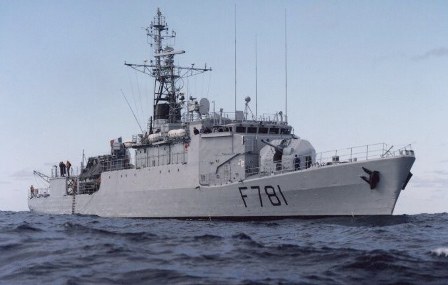
Description
The D'Estienne d'Orves class, also designated as the A69 type, is a series of avisos developed for the French Navy to replace the E 50 and E 52 class escorteurs. Constructed by the Arsenal de Lorient, the vessels were designed for coastal anti-submarine warfare and colonial patrol duties. The class is named after Honoré d'Estienne d'Orves, a French naval officer.
The design emphasizes endurance and reliability for overseas presence and high-sea escort missions, including support for the Strategic Oceanic Force. Propulsion is provided by diesel engines driving two shafts with controllable pitch propellers. This mechanical configuration was chosen to favor operational range over maximum speed. Most vessels in the class are equipped with fin stabilizers.
The original armament suite consisted of a main gun turret, secondary cannons, machine guns, and surface-to-surface missiles. Anti-submarine capabilities included a hull-mounted sonar, fixed torpedo catapults, and a remote-controlled rocket launcher. The electronic suite comprises air and surface sentry radars, fire control systems, and navigation radar. Defensive equipment includes radar interceptors, decoy launchers, and acoustic countermeasure systems.
Several modifications were implemented during the service life of the class. Funnels were heightened to improve exhaust gas clearance, and certain vessels received satellite communication terminals. In 2009, the French Navy reclassified its remaining units as offshore patrol vessels. During this transition, the ships were stripped of their surface-to-surface missiles and heavy anti-submarine weapons, though they retained the hull sonar for coastal operations.
A total of 20 vessels were completed. In addition to the French Navy, the class was adopted by the Argentine and Turkish navies. Argentina acquired three units, including two originally ordered by the South African Navy that were diverted following United Nations sanctions. Turkey acquired six former French Navy vessels starting in 2000 to conduct coastal patrols. The French Navy began the incremental withdrawal of the class in 2024, with the final units scheduled for retirement by 2027 to be replaced by a new class of patrol vessels. Argentine units were retired by 2024.