Floreal-class
Summary
| Origin country | 🇫🇷 France |
| Category | Frigate |
| Subtype | Frigate |
| Manufacturer | Chantiers de l'Atlantique |
| Year commissioned | 1992 |
| Units | Floréal, Prairial, Nivôse, Ventôse, Vendémiaire, Germinal, Mohammed V, Hassan II |
Technical specifications
| Displacement | 2642 tons |
| Range | 9000 km at 15 knots |
| Crew | 90 members |
| Width | 14.0 m (45.9 ft) |
| Length | 93.5 m (306.8 ft) |
| Air Park |
|
| Propulsion | 4 × SEMT Pielstick 6 PA6 L280 BPC diesel engines, 6,580 kW (8,820 hp), 2 shafts, 1 × 203 kW (272 hp) bow thruster |
| Armament | |
| Maximum speed | 20 knots |
Description
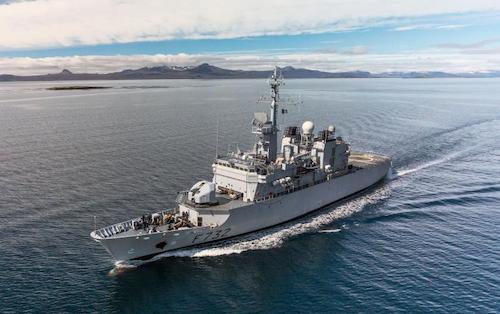
The Floréal class is a series of light surveillance frigates (frégates de surveillance) ordered by the French Navy in 1989. Designed for low-threat environments in territorial waters and exclusive economic zones, the vessels were built by Chantiers de l'Atlantique in Saint-Nazaire. Construction followed commercial ship standards to reduce costs, a method also applied to the later La Fayette class. Six ships were completed for France between 1990 and 1993, while two were constructed for the Royal Moroccan Navy between 2001 and 2002.
The hull and superstructure are made of welded steel with transverse bulkheads. Propulsion is provided by a combined diesel and diesel (CODAD) system driving two shafts with controllable pitch propellers. The design incorporates a bow thruster and fin stabilizers. For ease of maintenance, all diesel engines are situated within a single machinery room, and fuel is taken aboard at a single location at the stern. Sensors consist of air sentry, navigation, and landing radars, supported by communications intercept and radar intercept electronic surveillance systems. The ships feature a stern flight deck and hangar, supporting helicopters such as the Panther, Dauphin N3, or Alouette III. Armament for the French vessels includes a CADAM turret, modèle F2 guns, and Mistral point defense missiles. Exocet surface-to-surface missiles were originally fitted but were removed in 2014. Moroccan variants utilize an Otobreda gun and can be fitted with Simbad surface-to-air missiles. The ships are also equipped with medical facilities, including consultation rooms and hospital beds for humanitarian missions.
French units are stationed in overseas departments and regions, including Réunion, Nouméa, Tahiti, and Martinique. Their primary functions include maritime patrol, humanitarian assistance, and ship escort. Operational history includes participation in INTERFET in East Timor, Operation Enduring Freedom in the Persian Gulf, and Operation Atalanta off the Somali coast. The vessels have also been deployed for hurricane relief and aircraft wreckage recovery. The Royal Moroccan Navy uses its units, Mohammed V and Hassan II, for training and patrol duties. In French service, the class is expected to remain active until the mid-to-late 2030s, when they are slated for replacement by the European Patrol Corvette.