Fridtjof Nansen-class
Summary
| Origin country | 🇳🇴 Norway |
| Category | Frigate |
| Subtype | Multi-role frigate |
| Manufacturer | Navantia |
| Year commissioned | 2006 |
| Approx. unit cost | $489 million |
| Units |
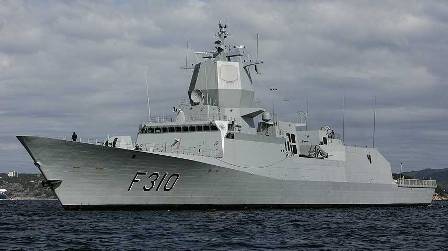
F310 HNoMS Fridtjof Nansen F311 HNoMS Roald Amundsen F312 HNoMS Otto Sverdrup F314 HNoMS Thor Heyerdahl |
Operators
Technical specifications
| Displacement | 5290 tons |
| Range | 4500 km at 16 knots |
| Crew | 120 members |
| Width | 16.8 m (55.1 ft) |
| Length | 134.0 m (439.6 ft) |
| Air Park |
|
| Propulsion | Combined diesel and gas turbine (CODAG): Two BAZAN BRAVO 12V 4.5 MW diesel engines, one GE LM2500 21.5 MW gas turbine, two shafts driving controllable pitch propellers, 1 MW Brunvoll retractable bow thruster |
| Thrust | 3600 hp |
| Armament |
|
| Maximum speed | 27 knots |
Description
The Fridtjof Nansen-class frigates serve as the primary surface combatants for the Royal Norwegian Navy. Developed to replace the Oslo class, the design transitioned from a specialized anti-submarine warfare focus to a multi-role configuration. The Norwegian government ordered five vessels from the Spanish shipbuilder Navantia in 2000, with the ships named after Norwegian explorers.
The class design is derived from the Spanish Álvaro de Bazán class and integrates the Aegis combat system. Propulsion is provided by a combined diesel and gas turbine (CODAG) system. Sensor systems include the AN/SPY-1F multifunction radar, air/sea surveillance radar, and an electro-optical director. Underwater detection is managed through a combat system incorporating hull-mounted sonar and active/passive towed array sonar. The ships utilize controllable pitch propellers and a retractable bow thruster. Aviation facilities were originally configured for NH90 helicopters; however, Norway announced the acquisition of MH-60R helicopters in 2023 to fulfill these requirements. A technical upgrade program for the class is scheduled to begin in 2025.
Operational service began with the commissioning of the lead ship in 2006. In 2009, HNoMS Fridtjof Nansen deployed to the Gulf of Aden for Operation Atalanta, where it conducted counter-piracy patrols and engaged suspected pirate vessels. In 2013, HNoMS Helge Ingstad participated in the international effort to remove chemical weapons from Syria, providing escort for transport vessels.
In November 2018, Helge Ingstad collided with a civilian oil tanker following a military exercise. The vessel was beached and subsequently sank. While the hull was recovered in 2019, the ship was decommissioned and scrapped in 2021 due to the cost of repairs. The remaining four vessels in the class remain in active service. In 2025, the Norwegian government selected the British Type 26 frigate as the successor class, with deliveries expected to begin in 2030.