Hatsuyuki-class
Summary
| Origin country | 🇯🇵 Japan |
| Category | Destroyer |
| Subtype | General-purpose destroyer |
| Manufacturer | Ishikawajima-Harima HI |
| Year commissioned | 1982 |
| Units | Hatsuyuki, Shirayuki, Mineyuki, Sawayuki, Hamayuki, Isoyuki, Haruyuki, Yamayuki, Matsuyuki, Setoyuki, Asayuki, Shimayuki |
Operators
Technical specifications
| Displacement | 2950 tons |
| Crew | 200 members |
| Width | 13.6 m (44.6 ft) |
| Length | 130.0 m (426.5 ft) |
| Air Park |
|
| Propulsion | 2 × KHI-RR TM3B gas turbines, 45,000 shp (34 MW); 2 × KHI-RR RM1C gas turbines, 9,900 shp (7.4 MW); 2 shafts, variable-pitch propellers |
| Armament |
|
| Maximum speed | 30 knots |
Description
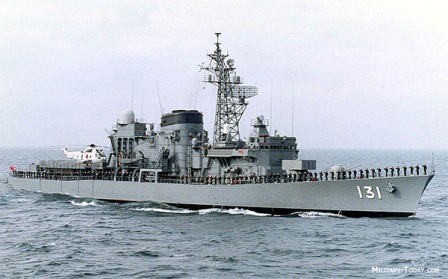
The Hatsuyuki-class destroyer was the first generation of general-purpose destroyers operated by the Japan Maritime Self-Defense Force (JMSDF). Developed in the 1970s, the class was designed to fulfill the "eight ships / eight helicopters" fleet organization concept. This doctrine required a new type of vessel, designated as a general-purpose destroyer (DD), to combine the anti-aircraft capabilities of previous DDA-type ships with the anti-submarine capabilities of DDK-type ships. The class was intended to address the reinforcement of Soviet anti-ship missiles and submarine fleets.
The hull design utilizes a shelter deck style and a long forecastle, with an underwater profile derived from the JDS Amatsukaze. The Hatsuyuki class was the first JMSDF design to employ a combined gas or gas (COGOG) propulsion system, utilizing two gas turbines for cruising and two for high-speed operations. The engine arrangement was similar to British Type 21 frigates, which resulted in a lack of alternating engine room redundancy. Early vessels in the class featured aluminum superstructures, but starting with DD-129, steel was used for the bridge and other key elements to improve durability. This design change necessitated the installation of ballast, which affected displacement and maneuvering performance.
The class introduced shipboard helicopter operations to the JMSDF general-purpose destroyer fleet. Using a beartrap system, the vessels could operate HSS-2B and later SH-60J anti-submarine helicopters. The combat system centers on the OYQ-5 Tactical Data Processing System, which is capable of receiving automated data via Link-14. Sensors include air and surface search radars and the OQS-4 hull sonar. While initially planned to include towed array sonar (TASS), development delays resulted in the system being retrofitted to only four ships at a later date. Noise reduction is managed through the Prairie-Masker system, which was factory-installed starting with the third vessel and retrofitted to the first two.
Twelve ships were built between 1979 and 1986 by multiple Japanese shipyards, including Sumitomo Heavy Industries, Mitsubishi Heavy Industries, and Ishikawajima-Harima Heavy Industries. The vessels entered service between 1982 and 1987. During their operational history, four units—JS Shimayuki, JS Shirayuki, JS Setoyuki, and JS Yamayuki—were re-designated as training vessels. These ships retained their armament after conversion. The class was incrementally retired starting in 2010, with the final vessels decommissioned in 2021.