Landing Craft Air Cushion-class (LCAC)
Summary
| Origin country | 🇺🇸 United States |
| Category | Amphibious vessel |
| Subtype | Landing craft |
| Manufacturer | Textron Marine and Land Systems |
| Year commissioned | 1986 |
| Approx. unit cost | $41 million |
Operators
Technical specifications
| Displacement | 185 tons |
| Range | 300 km at 35 knots |
| Crew | 5 members |
| Width | 14.0 m (45.9 ft) |
| Length | 26.8 m (87.9 ft) |
| Propulsion | 4 Avco Lycoming TF40B, (4,390 hp; 3,270 kW) each |
| Thrust | 120 hp |
| Armament |
|
| Maximum speed | 70 knots |
Description
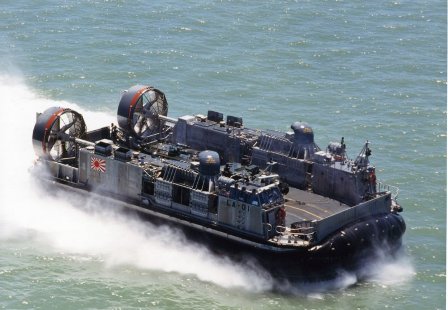
The Landing Craft Air Cushion (LCAC) development followed sea trials of the JEFF A and JEFF B prototypes, which began in late 1977. The United States Navy selected the JEFF B design in 1981, and the first production craft was delivered in 1984. Initial operational capability was achieved in 1986, and full production was approved in 1987. Manufacturing was conducted by Textron Marine & Land Systems and Avondale Gulfport Marine. A total of 97 units were produced, including 91 for the United States Navy and six for the Japan Maritime Self-Defense Force.
The craft utilizes four gas turbine engines for both lift and propulsion. These engines are interchangeable, and the craft maintains operation with two engines or one lift fan inoperable. The design features a cargo deck of 1,809 square feet with a 28.8-foot bow ramp and a 15-foot stern ramp. It can be configured with a Personnel Transport Model for 180 troops or 54 medical casualties. Starting in 2000, the Service Life Extension Program (SLEP) was implemented to increase the design life from 20 to 30 years. This program involves replacing the buoyancy box to mitigate corrosion and upgrading command, control, communications, computers, and navigation (C4N) electronics to an open-architecture suite using commercial off-the-shelf components.
In service, the LCAC is manned by a crew of five: craft master, navigator, craft engineer, deck engineer, and loadmaster. It is deployed from United States Navy amphibious ships equipped with well decks, including the Wasp, Whidbey Island, Harpers Ferry, and San Antonio classes. Primary missions include the transport of weapons systems, equipment, and personnel from ship to shore and across the beach. It also performs lane breaching, mine countermeasure operations, and casualty evacuation. The craft first deployed in 1987 aboard the USS Germantown and has since participated in various operations, including the 2004 Indian Ocean tsunami relief efforts. The United States Navy began receiving the Ship-to-Shore Connector as a replacement for the LCAC in 2019.