Murasame-class
Summary
| Origin country | 🇯🇵 Japan |
| Category | Destroyer |
| Subtype | General-purpose destroyer |
| Manufacturer | Ishikawajima-Harima HI |
| Year commissioned | 1996 |
| Unit | JS Murasame, JS Harusame, JS Yūdachi, JS Kirisame, JS Inazuma, JS Samidare, JS Ikazuchi, JS Akebono, JS Ariake |
Operators
Technical specifications
| Displacement | 6200 tons |
| Crew | 165 members |
| Width | 17.4 m (57.1 ft) |
| Length | 151.0 m (495.4 ft) |
| Air Park |
|
| Propulsion | 2 × IHI-GE LM2500 gas turbines, 2 × KHI-RR SM1C gas turbines, 60,000 shp (45 MW), 2 shafts, cp props |
| Armament |
|
| Maximum speed | 30 knots |
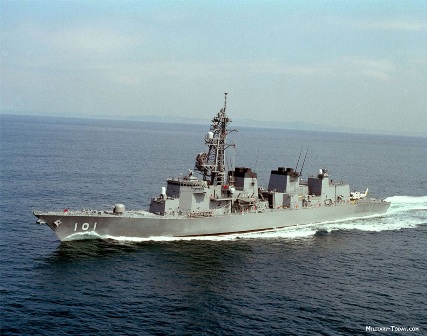
Description
The Murasame-class destroyer is a series of general-purpose vessels operated by the Japan Maritime Self-Defense Force (JMSDF). It is the first class of the JMSDF’s second-generation general-purpose destroyers. The class was developed following the completion of first-generation destroyers under the "eight ships / eight helicopters" concept, which sought to modernize flotillas consisting of helicopter destroyers, general-purpose destroyers, and guided-missile destroyers. The JMSDF initiated the Murasame class to replace first-generation vessels before they reached obsolescence. Nine ships were built between 1993 and 2000, with five additional units canceled.
The hull design was renovated from previous generations to reduce underwater radiation noise through increased size. Both the hull and superstructure are inclined to reduce the radar cross-section. The ships do not use an angled tripod mainmast due to winter weather conditions in the Sea of Japan. The aft section utilizes a "mini-Oranda-zaka" configuration to prevent interference between mooring devices and helicopter operations. Propulsion is provided by a COGAG arrangement consisting of two Spey SM1C and two LM2500 gas turbines.
Combat systems are based in part on the Kongō class. The OYQ-9 combat direction system uses large-screen displays, while the OYQ-103 anti-submarine warfare system integrates data from the hull-mounted array, towed array, and sonobuoys. Electronic systems include the OPS-24 active electronically scanned array radar, the OPS-28 surface search radar, and the NOLQ-3 electronic warfare suite. For armament, the class transitioned from swivel launchers to vertical launching systems (VLS), specifically the Mk 41 and Mk 48. These systems deploy anti-submarine rockets and point defense missiles. The point defense system transitioned from the Sea Sparrow to the Evolved Sea Sparrow by 2012. Surface-to-surface missiles are the Japanese-made SSM-1B. The aircraft facilities accommodate two SH-60J/K helicopters, with one aircraft serving as the standard load.
The class entered service in 1996 with the commissioning of the Murasame. Eight subsequent vessels—Harusame, Yudachi, Kirisame, Inazuma, Samidare, Ikazuchi, Akebono, and Ariake—were commissioned between 1997 and 2002. These ships operate out of Yokosuka, Sasebo, Ominato, and Kure. All vessels in the class remain in active commission.