Papa-class
Summary
| Origin country | 🇨🇳 Ex-USSR |
| Category | Submarine |
| Subtype | Nuclear-powered cruise-missile submarine |
| Manufacturer | Sevmash |
| Year commissioned | 1970 |
| Units | K-222 |
Operators
Technical specifications
| Displacement | 5197 tons |
| Displacement submerged | 7000 tons |
| Range | Unlimited, except by food supplies |
| Endurance | 70 |
| Crew | 82 members |
| Width | 11.5 m (37.7 ft) |
| Length | 106.92 m (350.8 ft) |
| Max. depth | 400 m (1312.3 ft) |
| Propulsion | 2 × VM-5 nuclear reactors; 2 × shafts; 2 × steam turbines producing 80,000 PS (59,000 kW) |
| Armament |
|
| Maximum speed | 25 knots |
| Max. speed submerged | 44 knots |
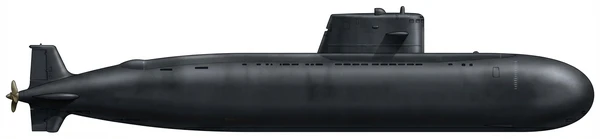
Description
The Soviet government authorized the development of Project 661, designated the Papa class by NATO, in 1958. Designed by TsKB-16, the project was intended to address the limitations of the Echo class, specifically the requirement to surface when launching missiles. The program sought a vessel capable of submerged missile launches with increased speed and diving depth. Construction of the sole vessel, K-222 (originally K-162), began at the Sevmash shipyard in 1963. The project served as a technical precursor for titanium hull construction, requiring the development of new fabrication and welding techniques in argon-shielded environments.
The Papa class featured a double-hull construction utilizing titanium alloys to provide high strength and non-magnetic properties. The inner hull was divided into nine watertight compartments, with a figure-8 configuration in the bow. This arrangement housed the torpedo tubes in the upper section and the sonar system and batteries in the lower section. Propulsion consisted of two nuclear reactors and two steam turbines driving twin shafts. While the design achieved the highest underwater speed of any manned submarine, it lacked acoustic damping. The resulting noise during high-speed operations was compared to a jet aircraft and interfered with the sonar's ability to track targets. The primary armament consisted of anti-ship cruise missiles housed in individual tubes between the hulls, angled for submerged launch.
K-222 was commissioned into the Red Banner Northern Fleet in 1969. During a 1971 deployment in the North Atlantic, the submarine conducted high-speed tracking of a United States Navy carrier battle group. The vessel underwent extensive repairs between 1972 and 1975 to address cracks discovered in the hull. In 1980, the submarine suffered a reactor accident during refueling when unauthorized procedures led to the overheating of the core and a release of radioactive steam into the machinery compartment. Following repairs and decontamination, the vessel completed a final patrol in 1981 before being removed from active service in 1988. The Soviet Navy declined further production of the class due to high construction costs, technical complexity, and high noise levels. However, the technologies developed for the Project 661 titanium hull were utilized in subsequent designs, including the Alfa and Sierra classes. K-222 was scrapped in 2010.