Romeo-class
Summary
| Origin country | 🇨🇳 Ex-USSR |
| Category | Submarine |
| Subtype | Diesel-electric submarine |
| Manufacturer | Krasnoye Sormovo Shipyard |
| Year commissioned | 1957 |
| Unit | Ex-303 Ex-Great Wall 107 |
Technical specifications
| Displacement | 1475 tons |
| Displacement submerged | 1830 tons |
| Range | 9000 km at 9 knots |
| Crew | 54 members |
| Width | 6.7 m (22.0 ft) |
| Length | 76.6 m (251.3 ft) |
| Propulsion | Two diesels delivering 2.94 MW (4000 shp) with two electric motors driving two shafts. |
| Armament |
|
| Maximum speed | 15 knots |
| Max. speed submerged | 13 knots |
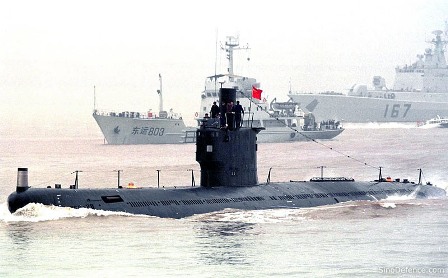
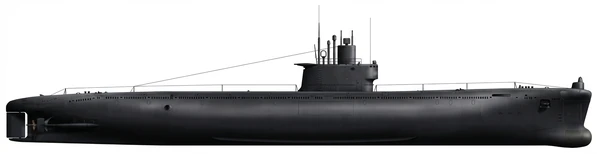
Description
Project 633, identified by the NATO reporting name Romeo, is a Soviet diesel-electric submarine design developed by the Lazurit Central Design Bureau. Originating as a derivative of the German Type XXI submarine, the class was intended as a successor to the Whiskey-class (Project 613). The Soviet Union produced 20 units at the Krasnoye Sormovo Shipyard between 1957 and 1961. Production was halted before the completion of the planned 56 vessels due to the introduction of nuclear-powered submarines into the Soviet Navy.
In 1963, the Soviet Union transferred technical documentation for the class to China under the Sino-Soviet Friendship and Mutual Assistance Treaty. China produced 84 units of the Type 033 variant between 1962 and 1984 at the Wuchang, Guangzhou, Jiangnan, and Bohai shipyards. North Korea also acquired the design, assembling 13 units from Chinese kits at the Mayang-do Naval Shipyard in addition to importing completed vessels.
Design characteristics evolved through several Chinese-developed variants. The initial Type 6633 transitioned to the Type 033, which incorporated improved refrigeration and air conditioning systems for operations in subtropical and tropical climates. Technical upgrades focused on sensor systems and noise reduction. Soviet-origin MARS-24 sonars were replaced by domestic Chinese Type 105, H/SQ2-262A, and Type 801 sonar systems. The Type 033G variant introduced analog computers for torpedo fire control, while the Type 033G1 was modified to carry six YJ-1 anti-ship missiles for surfaced launch. The ES5B export version added the capability to launch wire-guided torpedoes and anti-ship missiles while submerged. Noise reduction efforts in later variants lowered the acoustic signature by up to 20 dB compared to the original Project 633.
The Soviet Navy operated 20 vessels until their withdrawal from combat service, though some remained in use as immobile training facilities. The People's Liberation Army Navy operated approximately 84 Type 033 submarines, most of which are now retired or preserved as museum ships. North Korea currently operates 20 Romeo-class submarines; in 2023, it unveiled the Hero Kim Kun Ok, a modified variant designated as a tactical nuclear attack submarine. The Egyptian Navy maintains four upgraded units originally sourced from China. Former operators include the navies of Algeria, Syria, and Bulgaria. The Bulgarian Navy decommissioned its final Romeo-class vessel, the Slava, in 2011. Several units are preserved as museum ships in China, Russia, and Bulgaria.