San Antonio-class (LPD-17)
Summary
| Origin country | 🇺🇸 United States |
| Category | Amphibious vessel |
| Subtype | Amphibious transport dock |
| Manufacturer | Avondale Shipyard |
| Year commissioned | 2006 |
| Approx. unit cost | $1602 million |
| Units |
LPD-17 USS San Antonio LPD-18 USS New Orleans LPD-19 USS Mesa Verde LPD-20 USS Green Bay LPD-21 USS New York LPD-22 USS San Diego LPD-23 USS Anchorage LPD-24 USS Arlington LPD-25 USS Somerset LPD-26 USS John P. Murtha LPD-27 USS Portland LPD-28 USS Fort Lauderdale LPD-29 USS Richard M. McCool Jr. |
Operators
Technical specifications
| Displacement | 25300 tons |
| Range | 8000 km at 18 knots |
| Crew | 361 members |
| Width | 32.0 m (105.0 ft) |
| Length | 208.0 m (682.4 ft) |
| Air Park |
|
| Propulsion | Four sequentially turbocharged marine Colt-Pielstick diesel engines, two shafts, 41,600 shp |
| Thrust | 12500 hp |
| Armament |
|
| Maximum speed | 22 knots |
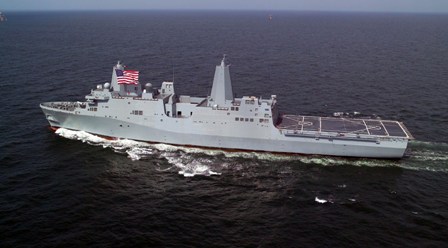
Description
The San Antonio class is a series of amphibious transport docks (LPD) operated by the United States Navy. Designed to replace the Austin, Newport, Charleston, and Anchorage classes, construction began in 2000 at Avondale Shipyard. Following 2014, production transitioned to Ingalls Shipbuilding. The program is divided into 13 Flight I ships and a planned 13 Flight II ships. The first vessel, USS San Antonio, entered commission in 2006.
The design incorporates a fiber-optic shipboard-wide area network (SWAN) to connect integrated systems and the Ship Self-Defense System (SSDS) for automated reaction against air threats. To reduce radar cross-section, Flight I vessels utilize the Advanced Enclosed Mast/Sensors (AEM/S) System, an octagonal composite structure that encloses antennas. Starting with USS Fort Lauderdale (LPD-28), the composite mast was replaced with a conventional mast design. The ships feature a floodable well deck for the operation of air cushion (LCAC) or conventional landing craft (LCU). The flight deck and hangar support the launch, landing, and storage of MV-22 Osprey tilt-rotor aircraft. Survivability features include shock-hardened structures and protection against nuclear blasts and fragmentation. Onboard medical facilities consist of two operating rooms and 124 beds. The class is the first in the U.S. Navy designed to accommodate both male and female sailors and Marines within the crew and embarked landing forces.
Operational assessments in 2010 and 2011 by the Director, Operational Test and Evaluation identified deficiencies in the lead ship, stating the vessel was not operationally effective or survivable in hostile environments at that time. In December 2022, USS Portland served as the recovery vessel for the uncrewed Artemis 1 Orion spacecraft capsule. In 2018, the Navy transitioned to Flight II production, beginning with LPD-30, to replace the Whidbey Island-class dock landing ships. Flight II ships include more than 200 design changes, including the integration of the AN/SPY-6 Enterprise Air Surveillance Radar. Although the Navy proposed a procurement pause in 2023 to evaluate future requirements, Congress authorized a multi-year procurement of three additional ships in August 2024 for fiscal years 2025 through 2029. As of 2024, thirteen ships are active, with several Flight II hulls under construction or authorized.