Shirane-class
Summary
| Origin country | 🇯🇵 Japan |
| Category | Destroyer |
| Subtype | Destroyer |
| Manufacturer | Ishikawajima-Harima Heavy Industries |
| Year commissioned | 1980 |
| Units | Shirane, Kurama |
Operators
Technical specifications
| Displacement | 5200 tons |
| Crew | 350 members |
| Width | 17.5 m (57.4 ft) |
| Length | 159.0 m (521.7 ft) |
| Air Park |
|
| Propulsion | 2 × IHI boilers, 2 × turbines, 2 shafts, 70,000 shp |
| Armament |
|
| Maximum speed | 31 knots |
Description
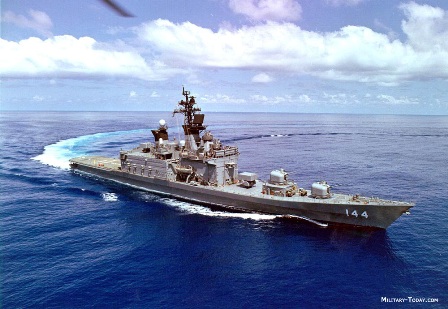
The Shirane class was a two-ship class of destroyers operated by the Japan Maritime Self-Defense Force. Developed in the late 1970s as a successor to the Haruna class, the vessels were constructed by Ishikawajima-Harima Heavy Industries and entered service between 1980 and 1981.
The design was an iteration of the Haruna class and featured a central hangar capable of housing three anti-submarine helicopters. Propulsion utilized steam boilers and turbines driving the shafts. The sensor suite consisted of air-search and surface-search radars, bow sonar, and variable depth sonar. Electronic warfare capabilities were provided by an integrated suite and decoy launchers. Armament systems included surface-to-air missiles, anti-submarine rockets, guns, and torpedoes.
The class consisted of the Shirane (DDH-143) and the Kurama (DDH-144). Shirane was based at Yokosuka and remained in service until 2015. In December 2007, a fire in the rudder house area occurred while the ship was anchored at Yokosuka; the fire took seven hours to extinguish and resulted in four injuries. Kurama was based at Sasebo and served until 2017. In October 2009, Kurama collided with a South Korean container ship in the Kanmon Straits. The collision caused fire and damage to the ship’s bow, injuring three crew members. The Shirane class was succeeded by the Hyūga class and replaced by the Izumo class.