Shivalik-class
Summary
| Origin country | 🇮🇳 India |
| Category | Frigate |
| Subtype | Guided-missile frigate |
| Manufacturer | Mazagon Dock Limited |
| Year commissioned | 2010 |
| Approx. unit cost | $650 million |
| Units |
F47 INS Shivalik F48 INS Satpura F49 INS Sahyadri |
Operators
Technical specifications
| Displacement | 6200 tons |
| Range | 5000 km at 18 knots |
| Crew | 257 members |
| Width | 16.9 m (55.4 ft) |
| Length | 144.0 m (472.4 ft) |
| Air Park | |
| Propulsion | CODOG: 2 × Pielstick 16 PA6 STC Diesel engines (11,300 kW each) and 2 × GE LM2500+ (25,100 kW each) |
| Thrust | 4000 hp |
| Armament |
|
| Maximum speed | 32 knots |
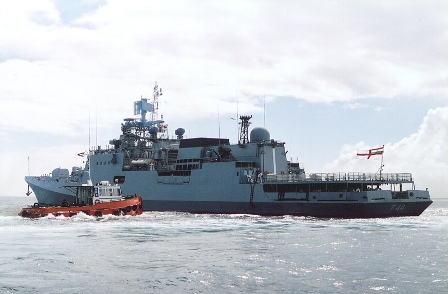
Description
The Shivalik class, designated Project 17, originated in the 1990s to fulfill an Indian Navy requirement for indigenously designed frigates. The Directorate of Naval Design developed the specifications, which required signature suppression and management features. These vessels succeeded the Talwar class and serve as the design basis for the follow-on Nilgiri-class frigates. Mazagon Dock Limited received formal orders for the three units in early 1999.
Construction of the lead ship, Shivalik, began in 2000, followed by Satpura in 2002 and Sahyadri in 2003. All three vessels were in commission by 2012. The class incorporates structural, thermal, and acoustic stealth features and is the first Indian naval design to utilize a combined diesel or gas (CODOG) propulsion system. The gearboxes for this system were designed and built by Elecon Engineering. The vessels possess land-attack capabilities and increased accommodation space for the complement. Onboard facilities include automated food preparation equipment, such as chapati and dosa makers. In 2023, the Defence Acquisition Council approved the procurement of updated missile launchers and fire control systems for the class.
The vessels have operated in the Indian Ocean, North West Pacific, and South China Sea. In 2012, Shivalik participated in JIMEX, the first bilateral maritime exercise between India and Japan. The vessel also conducted a goodwill visit to Shanghai and a passage exercise with the People's Liberation Army Navy. Shivalik later attended the 65th anniversary celebrations of the Chinese navy in Qingdao, sailing from Port Blair without assistance from support ships. Satpura participated in Malabar 2012, an exercise involving the United States Navy, and represented India at Rim of the Pacific (RIMPAC) 2016. The vessels are named after Indian hill ranges: the Shivalik, Satpura, and Sahyadri.