Dhruv
Indian utility helicopter, notable for extensive deployment in diverse Indian military and civil operations since the early 2000s. Key figures: top speed 280 km/h, range 630 km, service ceiling 4,400 m, max takeoff weight 5,580 kg, unit price $12M, built 335. In service with 3 air forces as of 2026 — India (287), Maldives (2), Nepal (1).
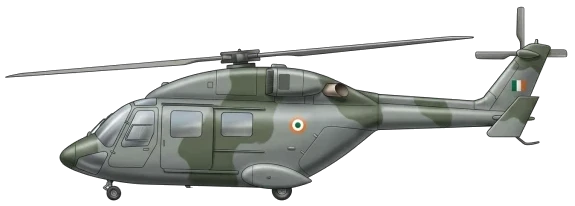
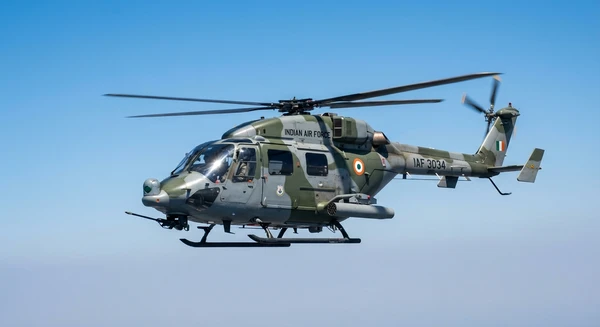
| Crew | 2 |
| Length | 15.9 m (52.1 ft) |
| Wingspan | 13.2 m (43.3 ft) |
| Height | 5.0 m (16.3 ft) |
| Empty weight | 4,445 kg (9,800 lbs) |
| Max. takeoff weight | 5,580 kg (12,302 lbs) |
| Powerplant | 2 × turboshafts Turbomeca TM333-2B2 807 kW each |
| Maximum speed | 280 km/h (174 mph) |
| Operational range | 630 km (391 mi) |
| Service ceiling | 4,400 m (14,436 ft) |
| Climb rate | 10.33 m/s (33.9 ft/s) |


Description
The HAL Dhruv is an Indian utility helicopter designed and manufactured by Hindustan Aeronautics Limited (HAL). Development began in 1984, and the type entered operational service in March 2002. It performs multirole military functions—including utility transport, reconnaissance, search and rescue, and medical evacuation—as well as civilian transport. The aircraft is known for high-altitude operating performance in extreme environments such as the Siachen Glacier.
Development
The Advanced Light Helicopter program was initiated in May 1979 by the Indian Air Force and Naval Air Arm, with HAL receiving a development contract in 1984 alongside design consultant Messerschmitt-Bölkow-Blohm. The first prototype flew on 20 August 1992. Sanctions following India's 1998 Pokhran-II nuclear tests caused an embargo on the intended LHTEC T800 engine, leading HAL to adopt the Turbomeca TM 333-2B2 and jointly develop the Shakti engine, which first flew on the Dhruv in August 2007. Over 400 units had been produced for domestic and export markets by January 2024.
Design
Composite materials constitute 29 percent of the aircraft's empty weight and 60 percent of its airframe surface area. It is powered by two turboshaft engines—either Turbomeca TM 333-2B2 or Shakti-1H units—driving a four-blade composite main rotor. The cabin seats up to 14 passengers or 12 armed troops, while the Kevlar-and-carbon cockpit includes crashworthy seats and crumple zones. Onboard electronics include a four-axis automatic flight control system, Doppler navigation, and Israel Aerospace Industries observation and electronic warfare suites.
Armament
Offensive and defensive weapons systems are integrated into specialized variants of the platform. The armed Mk 4 (HAL Rudra) variant is designed to carry a 20 mm turret-mounted cannon, anti-tank guided missiles, and air-to-air missiles. The maritime Mk 3 MR variant carries a 12.7 mm heavy machine gun with an effective range of 1,800 meters and can mount up to two anti-submarine warfare torpedoes.
Operational History
The Dhruv entered service with the Indian Coast Guard, Navy, Army, and Air Force in March 2002. Indian Army Dhruvs operated in high-altitude environments, reaching flight altitudes of 27,500 feet in the Siachen sector and executing search and rescue operations during the 2013 North India floods. Export deliveries were made to operators in Nepal, Mauritius, the Maldives, Turkey, and Ecuador; Ecuador retired its fleet in 2015 following four crashes. The fleet experienced several technical groundings, including fleetwide suspensions in 2005 due to tail rotor vibrations and between 2023 and 2025 following swashplate bearing and control rod failures.
Variants
- Mk 1: Initial military production variant equipped with mechanical cockpit gauges and Turbomeca TM 333-2B2 engines.
- Mk 2: Military variant incorporating a glass cockpit co-developed with Israel Aerospace Industries.
- Mk 3: High-altitude military variant powered by Shakti-1H engines and fitted with an electronic warfare suite and electro-optical pod.
- Mk 3 MR: Marine reconnaissance variant equipped with a search radar, electro-optical sensor pod, searchlight, and heavy machine gun.
- Dhruv NG: Fourteen-seat civil variant powered by Shakti-1H1C engines featuring a civil-certified glass cockpit and a 5,500 kg maximum takeoff weight.
Frequently Asked Questions
What type of aircraft is the Dhruv?
What is the maximum speed of the Dhruv?
What is the range of the Dhruv?
When did the Dhruv first fly?
How many Dhruv have been built?
Which countries operate the Dhruv?
How much does a Dhruv cost?
What is the service ceiling of the Dhruv?
- AUG 62026 Updated Description updated
- AUG 52026 Updated Powerplant updated in a site-wide editorial pass
- APR 72026 Updated Picture credits updated in a site-wide editorial pass
- FEB 72026 Updated Wingspan added
- JAN 242026 Updated Top speed updated
- JAN 122026 Updated Range updated in a site-wide editorial pass