Sjoormen-class
Summary
| Origin country | 🇸🇬 Singapore |
| Category | Submarine |
| Subtype | Submarine |
| Manufacturer | Kockums |
| Year commissioned | 1968 |
| Units | Sjöormen, Sjölejonet, Sjöbjörnen, Sjöhunden, Sjöhästen |
Technical specifications
| Displacement | 1075 tons |
| Displacement submerged | 1400 tons |
| Endurance | 21 |
| Crew | 23 members |
| Width | 6.1 m (20.0 ft) |
| Length | 51.0 m (167.3 ft) |
| Max. depth | 150 m (492.1 ft) |
| Propulsion | 2 × Pielstick diesel, 1 × ASEA electric motor, 1 shaft, 2,200 brake horsepower (1,600 kW) |
| Armament |
|
| Maximum speed | 15 knots |
| Max. speed submerged | 20 knots |
Description
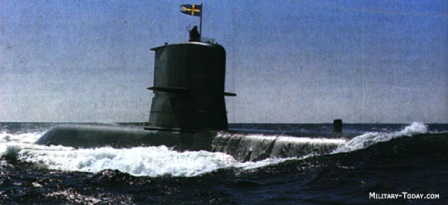
The Sjöormen class was a series of diesel-electric submarines developed for the Swedish Navy to succeed the Draken class. Ordered in 1961, construction was shared between the Kockums and Karlskrona shipyards. The class consisted of five vessels commissioned between 1968 and 1969.
The design utilized a teardrop hull shape based on the United States’ Barbel class and was configured for operations in the Baltic Sea. The vessels featured bow planes mounted on the sail and stern diving planes in an x-configuration. The hull was integrated with anechoic tiles. Propulsion consisted of a diesel-electric system driving a single shaft. Internal systems included surface search radar and sonar suites. During the 1980s, the class received upgraded fire control systems and sonar suites, with further electronics and towed array sonar refits performed on specific units in 1992. Armament consisted of bow and stern torpedo tubes, and the vessels were capable of deploying naval mines.
In Swedish service, the submarines operated from the late 1960s until the early 1990s. While several units were planned to remain active until the arrival of the Gotland class, the class was laid up in 1993 due to funding limitations. All five vessels were sold to the Republic of Singapore Navy in the late 1990s. Four units underwent modernization and a tropicalization program to adapt them for operations in different climates, subsequently entering service as the Challenger class. These units included the RSS Challenger, RSS Conqueror, RSS Centurion, and RSS Chieftain. The fifth vessel, formerly HSwMS Sjöhästen, was used for spare parts and was scrapped in the late 2000s. The Challenger class has since been decommissioned.