Swiftsure-class
Summary
| Origin country | 🇬🇧 United Kingdom |
| Category | Submarine |
| Subtype | Nuclear-powered fleet submarine |
| Manufacturer | Vickers Shipbuilding and Engineering Ltd. (VSEL) |
| Year commissioned | 1973 |
| Units | Swiftsure, Sovereign, Superb, Sceptre, Spartan, Splendid |
Operators
Technical specifications
| Displacement | 4400 tons |
| Displacement submerged | 4900 tons |
| Range | Unlimited, except by food supplies |
| Crew | 116 members |
| Width | 9.8 m (32.2 ft) |
| Length | 82.9 m (272.0 ft) |
| Max. depth | 300 m (984.3 ft) |
| Propulsion | Nuclear Reactor, shrouded pump-jet propulsors |
| Armament | |
| Maximum speed | 20 knots |
| Max. speed submerged | 30 knots |
Description
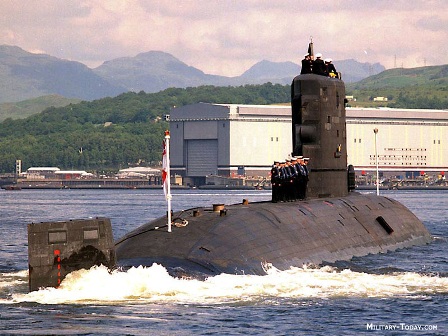
The Swiftsure class consisted of six nuclear-powered fleet submarines operated by the Royal Navy between 1973 and 2010. Produced by Vickers Shipbuilding and Engineering Ltd, the class followed the Churchill class and preceded the Trafalgar class.
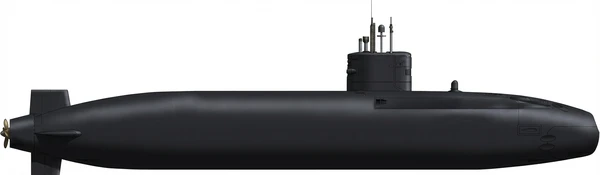
The hull design departed from the whale-shaped streamlining of earlier British nuclear submarines, maintaining a uniform diameter for a greater portion of its length. Compared to the preceding Valiant class, Swiftsure vessels were shorter with a fuller form and positioned the fore-planes further forward. This class introduced shrouded pump-jet propulsors to the Royal Navy, although the lead ship, HMS Swiftsure, was instead fitted with a traditional propeller. The pump-jet design allowed for lower revolutions and a reduced noise signature. To further limit acoustic output, machinery pipework utilized expansion and flexible coupling connections. While built to carry torpedoes and anti-ship missiles, several boats were later modified to launch Tomahawk cruise missiles.
Operational history included the 1982 Falklands War, where HMS Spartan and HMS Splendid were deployed to enforce a maritime exclusion zone. Spartan conducted reconnaissance of Argentine operations at Stanley. While neither boat fired weapons during the conflict, their presence restricted the movement of the Argentine Navy. In 1999, HMS Splendid fired Tomahawk missiles during the Kosovo War, becoming the first British submarine to do so in combat. The vessel also utilized these weapons during the 2003 invasion of Iraq.
The class recorded several mechanical and operational incidents. HMS Swiftsure was decommissioned in 1992 following pressure hull damage sustained during trials. In 1981, HMS Sceptre collided with a Soviet Delta III-class submarine. HMS Sovereign required emergency repairs in 1998 for tailshaft cracks discovered during sea trials. In 2000, HMS Sceptre moved off its cradle and sustained damage during drydock trials when an engine over-speed caused the vessel to break its moorings. HMS Superb was retired in 2008 after striking an underwater pinnacle in the Red Sea, which damaged its sonar and prevented it from submerging.
The class was phased out as boats reached the end of their service lives or were affected by defense spending reductions. The final boat in the class, HMS Sceptre, was decommissioned in December 2010.