Type 051-class (Luda)
Summary
| Origin country | 🇨🇳 China |
| Category | Destroyer |
| Subtype | Guided missile destroyer |
| Manufacturer | Luda Shipyard |
| Year commissioned | 1971 |
| Units |
Ex-106 Ex-Xi'an Ex-132 Ex-Hefei |
Operators
Technical specifications
| Displacement | 3670 tons |
| Range | 2970 km at 15 knots |
| Crew | 280 members |
| Width | 12.8 m (42.0 ft) |
| Length | 132.0 m (433.1 ft) |
| Air Park |
|
| Propulsion | 2 steam turbines, 72,000 shp (53,700 kW) |
| Armament |
|
| Maximum speed | 32 knots |
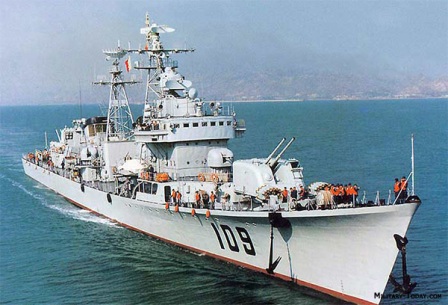
Description
The Type 051 destroyer, designated by NATO as the Luda class, was the first guided missile destroyer designed and built in China. Design work began in 1960 based on the Soviet Neustrashimy-class hull with elements of the Kotlin class. Progress was halted by the Sino-Soviet split and resumed in 1965, with construction of 17 vessels occurring between 1968 and 1991 at the Luda, Zhonghua, and Huangpu shipyards.
The class utilized steam turbine propulsion and was produced in several distinct batches and variants. Initial Type 051 ships were equipped with Soviet-derived systems, including HY-1 anti-ship missile launchers, twin 130 mm dual-purpose guns, and anti-submarine rocket launchers. The Type 051D variant incorporated revised electronics and equipment for underway replenishment. The Type 051Z served as a command variant using the ZKJ-1 combat data system and 3-D radar. Modernized variants, such as the Type 051DT and 051G, replaced earlier armament with YJ-83 anti-ship missiles and HQ-7 surface-to-air missiles. The Type 051G integrated French technology, including search sonar and variable depth sonar. In 1987, the ship Jinan was converted into a helicopter destroyer variant, replacing aft weaponry with a hangar and flight deck for Harbin Z-9C helicopters. Modernization programs involving British weapons and sensors or American power plants and computers were proposed in the 1980s but were cancelled before implementation.
The Type 051 entered service in 1971, though workmanship issues during the Cultural Revolution delayed full operational status for many ships until 1985. In 1978, the ship Guangzhou was lost following an explosion and subsequently scrapped. The class remained in active service until 2020. The final two ships, Zhanjiang and Zhuhai, were decommissioned in late 2020. Twelve vessels have been preserved as museum ships or tourist attractions, including Jinan, Yinchuan, Nanjing, Nanchang, Chongqing, Xining, Zhanjiang, Zhuhai, Hefei, Zunyi, Dalian, and Xi'an. Two retired vessels, Guilin and Kaifeng, were designated to be expended as target ships.