Type 052C-class (Luyang II)
Summary
| Origin country | 🇨🇳 China |
| Category | Destroyer |
| Subtype | Guided-missile destroyer |
| Manufacturer | Jiangnan Shipyard |
| Year commissioned | 2004 |
| Units |
150 Changchun 151 Zhengzhou 152 Jinan 153 Xi'an 170 Lanzhou 171 Haikou |
Operators
Technical specifications
| Displacement | 7000 tons |
| Range | 4500 km at 15 knots |
| Crew | 280 members |
| Width | 17.0 m (55.8 ft) |
| Length | 155.0 m (508.5 ft) |
| Air Park |
|
| Propulsion | Combined diesel or gas (CODOG): 2 × DA80 gas turbines (35.7 MW each) and 2 × MTU 20V 956TB92 diesels (6 MW each) |
| Armament |
|
| Maximum speed | 29 knots |
Description
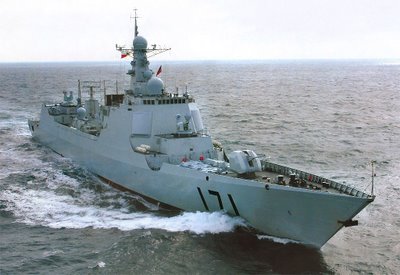
The Type 052C destroyer, designated by NATO as the Luyang II-class, is a series of six guided-missile destroyers operated by the People's Liberation Army Navy (PLAN). The class followed the Type 051C and Type 052B designs and was succeeded by the Type 052D. Construction began at the Jiangnan Shipyard in 2002. Following the completion of the first two vessels, a pause in construction occurred until 2010, which is attributed to the relocation of the shipyard and technical issues involving the propulsion system.
The Type 052C hull is derived from the Type 051B and incorporates stealth features. It represents a shift toward the use of Chinese-developed systems over the mixed Russian and Chinese hardware found in earlier classes. This class was the first in PLAN service to utilize fixed active electronically scanned array (AESA) radar and vertically launched surface-to-air missiles, providing the fleet with area air defense capabilities.
The propulsion system uses a combined diesel or gas (CODOG) configuration. This arrangement includes two Ukrainian DA80 gas turbines and two diesel engines produced under license in China. Reports indicate that blade problems with the gas turbines delayed the acceptance of the final two vessels in the class.
Sensors include the G-band Type 346 AESA radar for air search and fire control of the surface-to-air missiles, supplemented by specialized radars for air search, surface search, and gun fire control. Subsurface detection is provided by bow-mounted and towed array sonars. The vessel’s armament consists of HHQ-9 surface-to-air missiles, which utilize a cold-launch method from revolver-type vertical launchers. Anti-ship capability is provided by YJ-62 cruise missiles. The primary gun is a 100 mm PJ-87, though this system reportedly experienced jamming during operation. For close-in defense, the ships carry two Type 730 CIWS units. Anti-submarine systems include torpedo tubes and multiple rocket launchers. The class features a stern hangar and flight deck to support a single Kamov Ka-28 or Harbin Z-9 helicopter.
The six vessels of the class entered service between 2004 and 2015 and are assigned to the South Sea Fleet and East Sea Fleet. The Lanzhou and Haikou were the initial units commissioned. Later ships, including the Changchun, Zhengzhou, Jinan, and Xi'an, were built at the Jiangnan Shipyard’s Changxingdao location. The Xi'an participated in the RIMPAC exercise at Pearl Harbor in 2016. All six units of the class remain active.