Typhoon-class
Summary
| Origin country | 🇨🇳 Ex-USSR |
| Category | Submarine |
| Subtype | Ballistic missile submarine |
| Manufacturer | Sevmash |
| Year commissioned | 1981 |
| Units | TK-208 Dmitry Donskoy, TK-202, TK-12, TK-13, TK-17 Arkhangelsk, TK-20 Severstal, TK-210 |
Operators
Technical specifications
| Displacement | 23200 tons |
| Displacement submerged | 48000 tons |
| Range | Unlimited, except by food supplies |
| Endurance | 120 |
| Crew | 160 members |
| Width | 23.0 m (75.5 ft) |
| Length | 175.0 m (574.1 ft) |
| Max. depth | 400 m (1312.3 ft) |
| Propulsion | 2 × OK-650 pressurized-water nuclear reactors, 190 MWt each; 2 × geared steam turbines, 50,000 shp each; 2 shafts with 7-bladed shrouded screws |
| Armament |
|
| Maximum speed | 22 knots |
| Max. speed submerged | 27 knots |
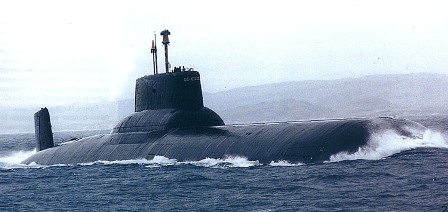
Description
Project 941 Akula, designated by NATO as the Typhoon class, was developed by the Rubin Design Bureau and constructed at the Sevmash shipyard for the Soviet Navy. The project originated as a response to the United States Navy's Ohio-class submarine. Because the Soviet R-39 ballistic missiles were larger and heavier than American counterparts, the vessel was designed with dimensions sufficient to accommodate the launch system.
The design is characterized by a multi-hull configuration consisting of several separate pressure hulls. Two primary pressure hulls run parallel to each other, joined by a smaller hull below the sail and additional hulls for the torpedo and steering systems. This arrangement increases the beam of the vessel and provides increased survivability, as the crew can remain safe in one pressure hull if another is breached. The missile launch tubes are positioned between the two main pressure hulls, enclosed by the outer light hull. The internal layout includes facilities intended to sustain the crew during extended submerged deployment.
Six vessels were completed between 1976 and 1989, while a seventh hull was cancelled before completion. The lead ship of the class entered service in 1981. Initially identified only by hull numbers, the vessels were later assigned names by the Russian Navy. During the 1990s, three units were decommissioned and subsequently scrapped. In 2004, the vessels Arkhangelsk and Severstal were placed in reserve.
The lead vessel, Dmitry Donskoy, underwent a refit to serve as a platform for testing the Bulava missile system. In 2012, the Russian Navy cancelled a modernization program for the remaining units, determining that the cost of refitting the class was equivalent to the construction of two new Borei-class submarines. Strategic arms reduction treaties and the successful introduction of the Borei class also contributed to the decision to retire the hulls. Proposals existed to convert the submarines into cargo vessels for transporting oil and gas under polar ice, though these refits were never implemented. The final active vessel, Dmitry Donskoy, was decommissioned in 2023. Plans were later announced to preserve the vessel as a museum ship.